Spring magic
A golden-green haze of flowers and young leaves starts to envelop the trees and winter-weary people know that spring has finally come. In our valleys it arrives on a warm sunny day in late April; but it will be two weeks or more before this delicate veil imperceptibly stretches up and over the mountaintops.

Spring beauties carpet the Vermont forests in early May
And all through the woods, free at last from winter’s snow, like magic, a host of dainty flowers push their way up through the carpet of crackly brown leaves.
Around my home, as in much of Vermont, the soil is predictably acidic, and in early May the forests are carpeted with our ephemeral wildflowers such as Spring Beauties (Claytonia virginica) and Trout Lilies (Erythronium americanum), punctuated with clusters of both the Red and the Painted Trillium.
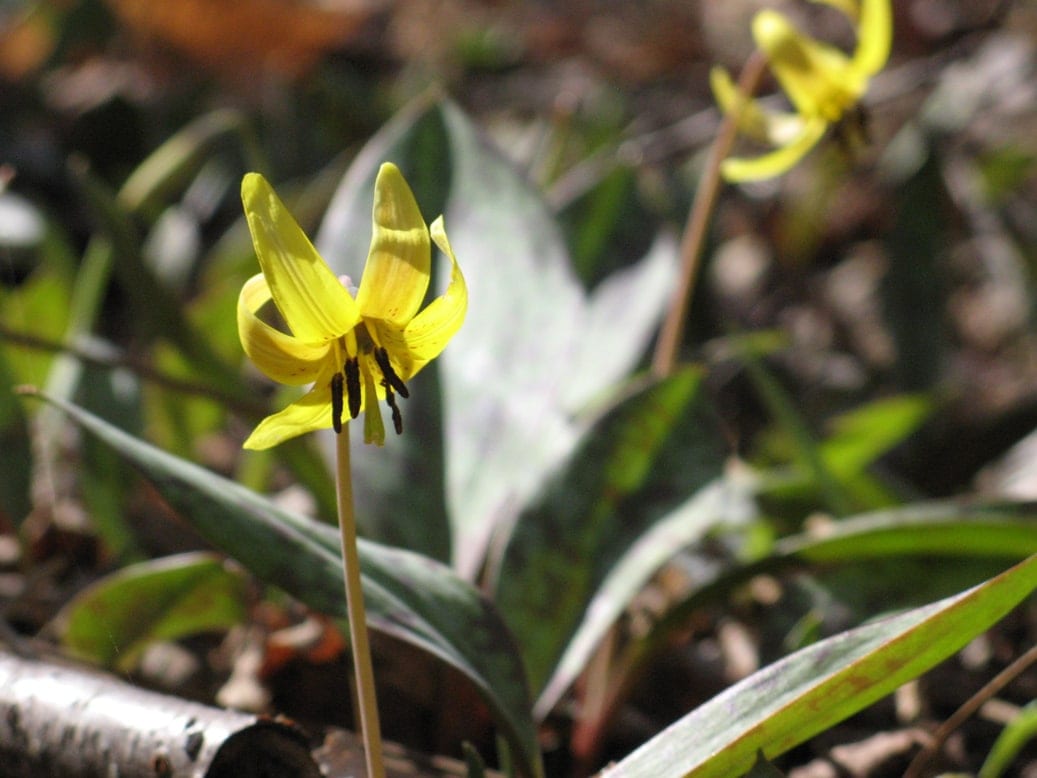
Dog-toothed violets are scattered throughout the woods
Every now and then I see other less-common beauties, such as Goldthread (Coptis groenlandica), and Starflower (Trientalis borealis). And I am always delighted to come across a sizable clump of squirrel corn (Dicentra canadensis), or its close relative Dutchman’s Breeches (Dicentra cucullaria) with the flowers hanging along the stem like laundry hung out to dry.

A host of Large flowered Trillium in these woods in Salisbury, Vermont, are indeed sight to behold.
But should you drive along the back roads in the limestone regions of state, be sure to keep an eye open for a colony of white Large-flowered trillium (Trillium grandiflorum) stretching back into the woods—a truly unforgettable sight. Since the Large-flowered Trillium require an alkaline soil they are extremely picky about their location; but in the right spot they will multiply without end, as this picture shows.
Spring Ephemerals are Nature’s Opportunists
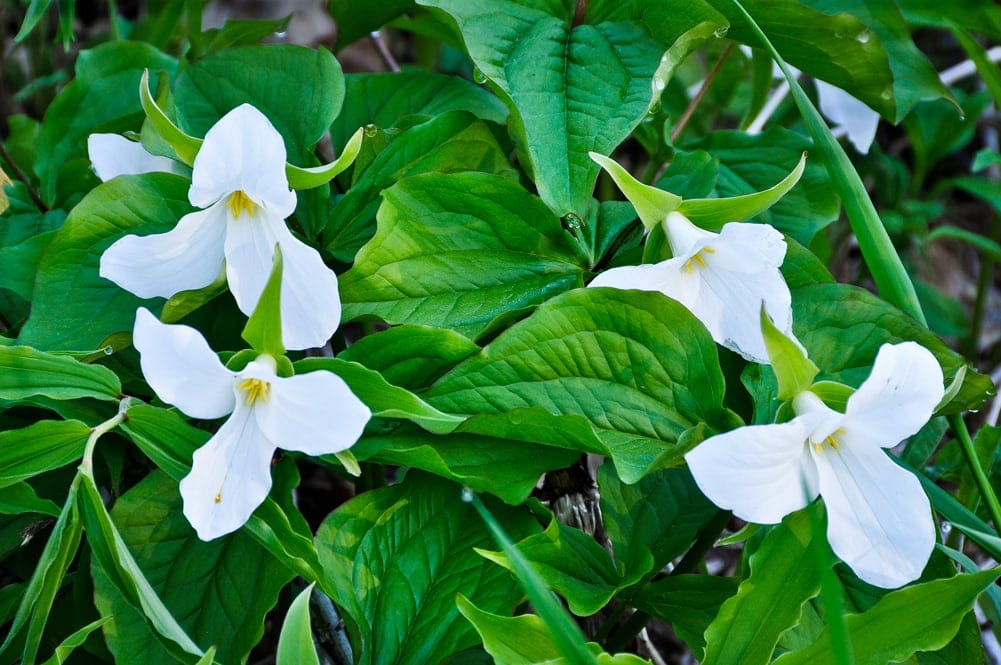
White trillium hold their heads high, for pollinating insects to find and for people to enjoy
All these diminutive spring plants are known as ‘ephemerals’, and they are nature’s opportunists. Their annual emergence is precisely timed to coincide with that brief window in May when the ground has fully thawed, but before the trees have fully leafed out and the sun is still illuminating the forest floor. In the span of a few short weeks these plants complete their entire annual cycle of leafing out, flowering, pollination and setting seed, after which they retreat below the ground until next spring.
Spring Ephemerals in the Garden

Given a little encouragement scilla will naturalize in our gardens, faithfully returning year after year
We have spring ephemerals in our gardens too— plants that hibernate when the weather gets hot.
First to flower, in late April in my garden, are the snowdrops, crocuses and scilla. Currently, in May, their leaves are still above ground, photosynthesizing to create the food that will be stored in the bulb. This in turn will create next year’s flower and thus continue the cycle.
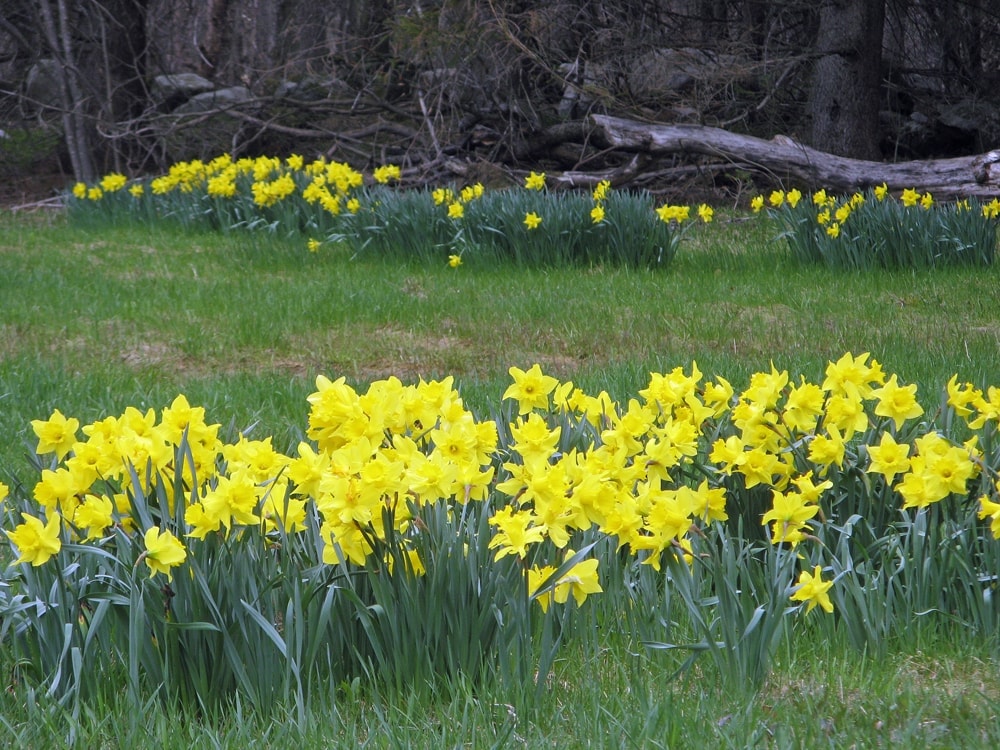
These amazing daffodils thrive in the meadow grasses, untended by anyone.
Right now and nicely timed for Mother’s Day, it is the peak of the daffodil season in my garden. Everywhere I look there are pools of flowers, both yellow and white. I planted the original bulbs many years ago now, and over time they have multiplied mightily. While many remain in the flower beds, I have been gradually relocating them to more naturalized areas in the meadow beside the pond and along the sunny edges of the woods.

Transatlantic companions: Virginia bluebells and English primroses
And the magic of the spring ephemerals is not yet over. Starting just a few days ago, the bed outside my study window came alive with the clearest blue of the Virginia bluebells. Over the years they have gradually self-seeded to form a good-sized colony and, as I write this, they are picture-perfect among clusters of pale yellow English primroses. These will be followed by some European bluebells which, although surviving here in Vermont, are nothing compared with the English bluebell woods of my childhood.
Two bleeding hearts (both relatives of the woodland Dutchman’s breeches and Squirrel Corn), the substantial Old-fashioned Bleeding Heart, (Dicentra spectabilis) and the smaller Fringed Bleeding Heart (Dicentra exima) also flower in May, as another reminder that winter is truly over. While the leaves of the fringed bleeding heart remains above ground, and may even reflower throughout the summer, you can expect the leaves of Dicentra spectabilis to die back to almost nothing after flowering, and thus can be also considered ephemeral.
Carefree spring ephemerals
The most important thing to remember about the spring ephemerals is to resist cutting the leaves back until after they have turned yellow, indicating the plant has completed its photosynthesis cycle. With snowdrops and crocuses this happens towards the end of May.
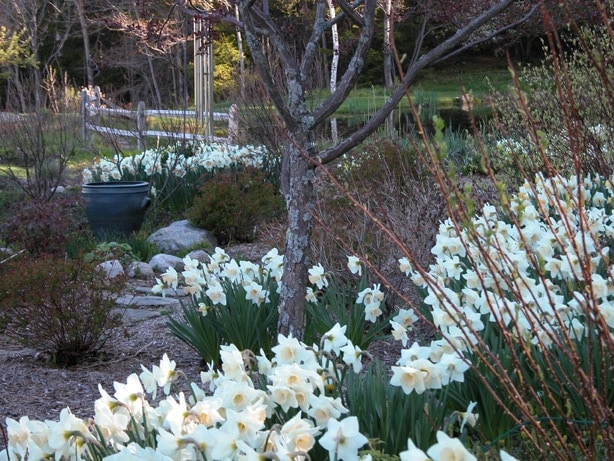
These daffodils are at the back of the flowerbed, so their leaves will be hidden by emerging perennials
But for daffodils this maturation process takes a lot longer meaning that, all through June, their leaves are still green and hard at work photosynthesizing food for next year, and should not be cut back. This is when we gardeners wring our hands at the sight of straggly daffodil leaves in front of the beautiful peonies in our flower beds.
So my advice is to—
Either plant your daffodils towards the back of your flower beds so their after-flowering presence is masked by other perennials growing up in front
Or plant them in a naturalized area such as in a meadow or at the edge of the woods where the leaves mature among the grasses.
And, unless you can resist mowing until July, avoid planting them in the lawn !!
And, if you want to relocate any daffodils that happen to be in the wrong spot, do it right after flowering while the leaves are still apparent. This is when you know where the bulbs are located, and thus avoid spiking them with a fork. Lift the clump, separate the bulbs and replant, leaf and all. It gives it time to grow new roots a new root system and, I promise you, it will not hurt the bulb at all.
Spring gold
Green and gold, yellow and white, with highlights of clear blue that match the sky—these are the quintessential colors of early spring.
But spring is fleeting and transient, and the picture ever-changing. Before long the crab apples and magnolias add their beautiful pinks and reds to the composition, soon to be followed by the soft lilac hues of Syringa vulgaris.
Speaking personally I prefer to skip the early PJM Azaleas entirely. I find the assertiveness of their brash purple color clashes with the mood of the season. I prefer instead to anticipate the arrival in June of the delicate ‘White Lights’ Azalea.
My spring mantra is to enjoy each day as it comes, for tomorrow the picture will change, as this well-loved poem by Robert Frost tells us so succinctly:
Nature’s first green is gold,
Her hardest hue to hold.
Her early leafs a flower;
But only so an hour.
Then leaf subsides to leaf.
So Eden sank to grief,
So dawn goes down to day.
Nothing gold can stay.