A century of separation
Manchester (Vermont) offers the visitor more than just a big shopping experience. It is also the home of two splendid public gardens.
This pair of gardens, just four miles apart but separated in time by a hundred years, couldn’t be more different and, as such, they provide the attentive visitor a quick lesson in how garden fashions have evolved over the past century.

Precisely clipped privet hedges at Hildene
The first, created in 1907, graces the grand manor house of Hildene, private summer home of Robert Todd Lincoln (son of President Lincoln) and his wife Mary. For some time now Hildene has been open to the public and is visited by thousands of people each year.
Many visitors come specifically to enjoy the vast estate, where the main garden is a formal masterpiece laid out with geometric precision, emulating the grand gardens of old Europe.
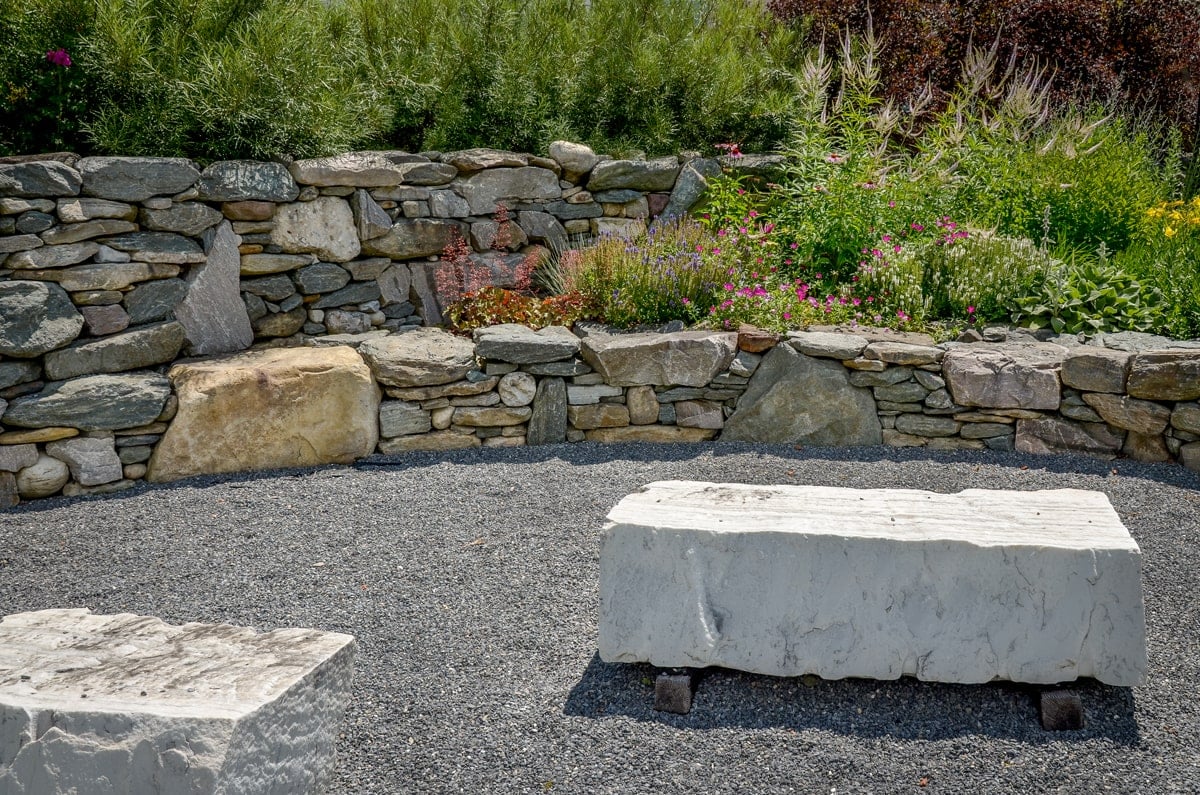
Stonework at Manchester’s Northshire garden
And, for a complete contrast, garden aficionados will also take pleasure in visiting a delightful contemporary garden tucked away behind the expansive Northshire bookstore. This is a quintessential 21st century garden complete with flowing lines, artistic stonework and an eclectic mix of flowers and shrubs.
From the outset it was designed for a public setting. It is close to the busy new roundabout that was built to replace Manchester’s infamous ‘malfunction junction’, but, despite its location in the center of town, this lovely garden is often overlooked by the visitor.
So, next time you are in Manchester, after browsing Northshire’s extensive bookstacks and perhaps finding that perfect book, be sure to leave through the rear door and pay a visit to their delightful ‘back garden’.
The gardens of Hildene
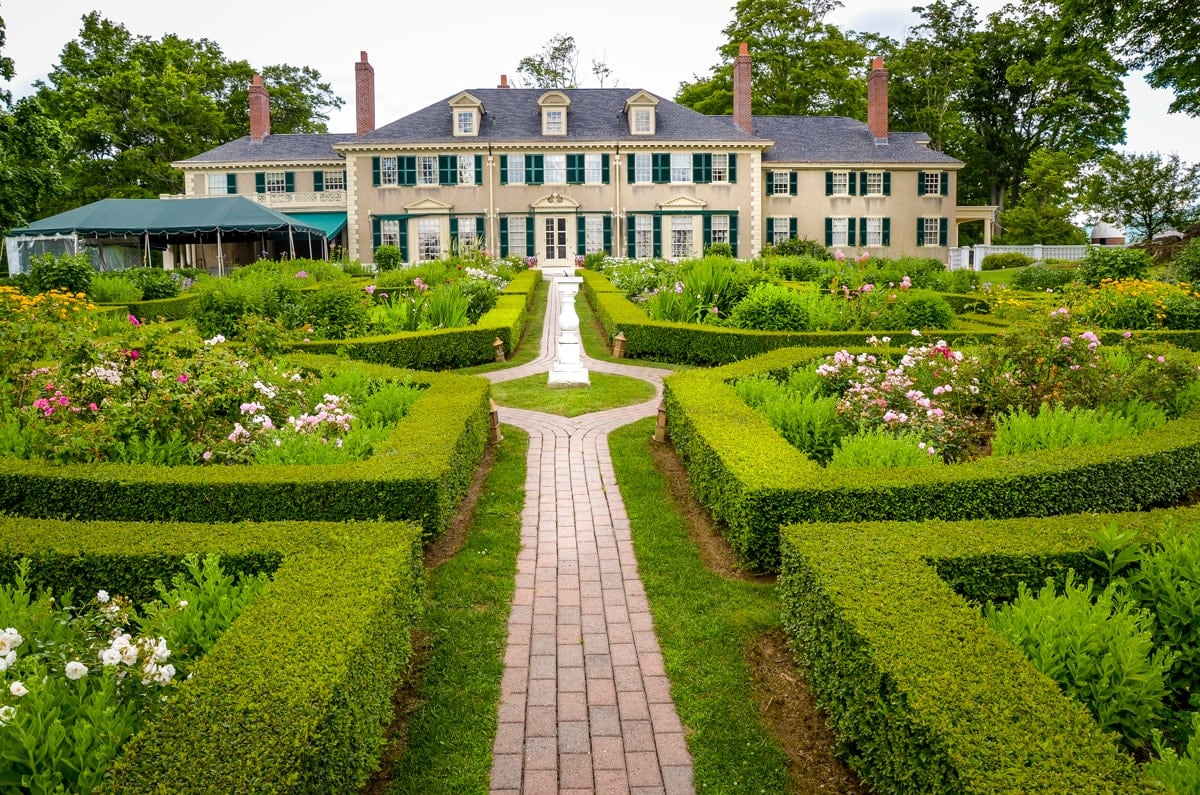
The house and grounds of Hildene have been open to the public for many years now. But, if it has been a while since you visited the gardens, do go again; you will be in for a delightful surprise.
Over the last few years the plant collections in the main garden have been restored and the renovated kitchen garden is once more productive. When we visited last July, I was more than impressed with how beautifully everything was maintained— no small feat, given the enormous size of the grounds and especially the main garden.

You know when you have ‘arrived’ at Hildene
Visiting Hildene is to take a trip back in time. After entering the main gates and strolling up the carriage road flanked by tall trees you come to the large circular driveway and the imposing mansion set on a high promontory; you have clearly ‘arrived’.
Continue on around behind the mansion to the long terrace, and you will find yourself facing the huge formal garden known as the Hoyt garden.
The Hoyt garden
This is an amazing creation and, with its strict attention to symmetry, it is the ultimate in formality. It was designed by the Lincoln’s daughter, Jesse, as a birthday gift for her mother, Mary.
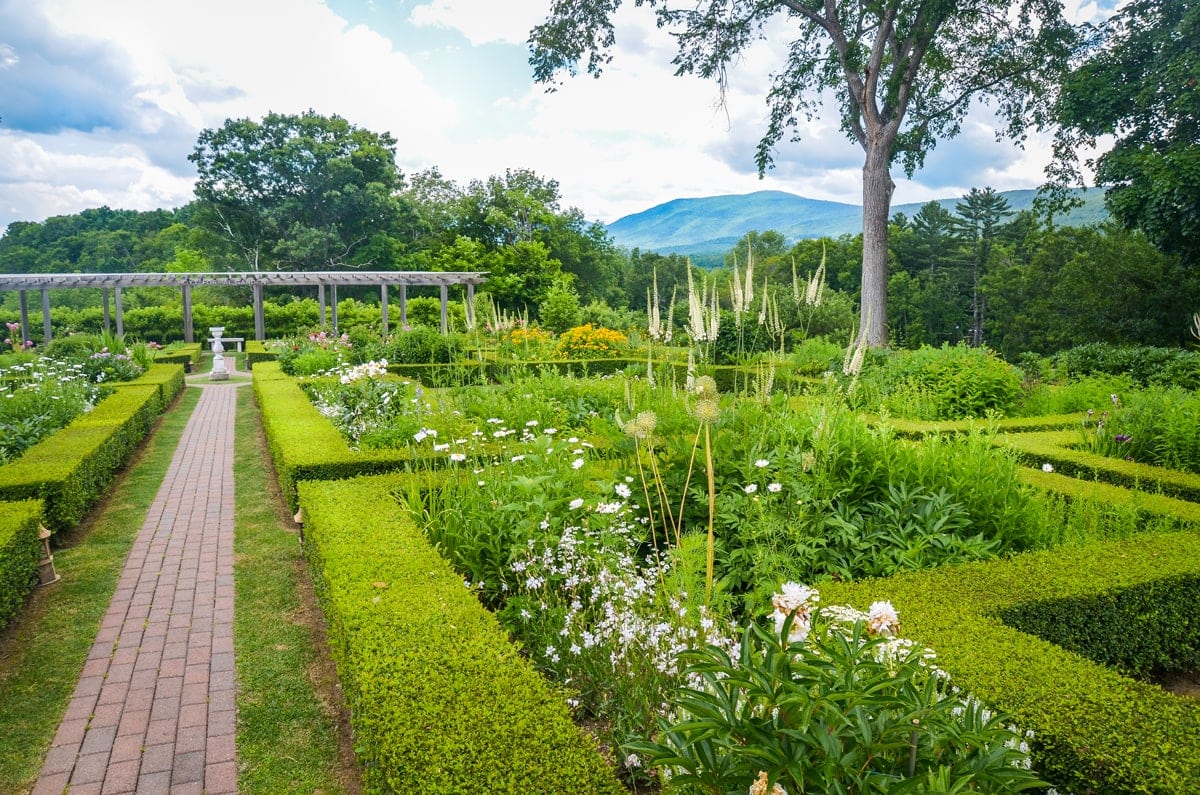
When viewed from her mother’s bedroom, in the center of the house on the second floor, you take in the entire panorama of the garden at once. Using the sweeping flat space behind the house, Jesse created it to resemble a stained-glass cathedral window, and styled it after a French parterre.
Standing on the terrace at the rear of the house you will be immediately aware of the pivotal central axis, running southwest and flanked by symmetrical flower beds on either side. The beds that make up each quadrant have complex outlines with a small lawn at the center, and each bed is delineated by a low clipped hedge of privet.
The long axis terminates in a semi-circular rose garden backed by an imposing pergola creating a shady spot with a grand view back to the house.
The Hoyt garden is justly famous for its peony collection, where over 1000 different types of peonies have been carefully documented against century-old records.
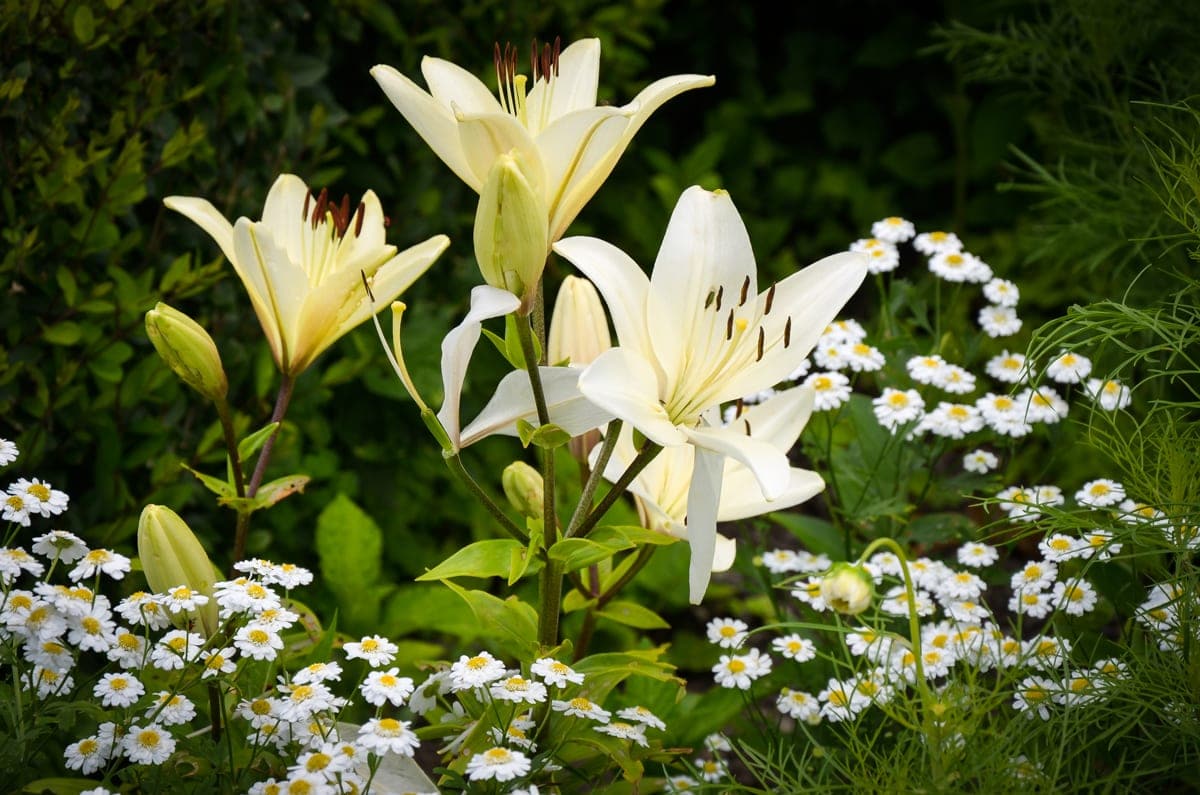
In the ‘white’ quadrant, the feverfew softens the large flowers of the daylilies.
But summer does not end when the peonies stop blooming. Each bed also contains plenty of summer blooming perennials, lilies and daylilies, salvia, Veronicrastum, Cimicifuga, feverfew and shasta daisies, with a different color theme assigned to each of the four quadrants of the garden.
Beyond the formal garden

Potted plants occupy a shady spot on the porch at Hildene
The large estate offers plenty of other attractions for the garden-minded visitor, starting with the ‘not to be missed’ containers of tender plants set in the shady porches around the house. Their big leaves and exotic color schemes surely made this gardener envious.
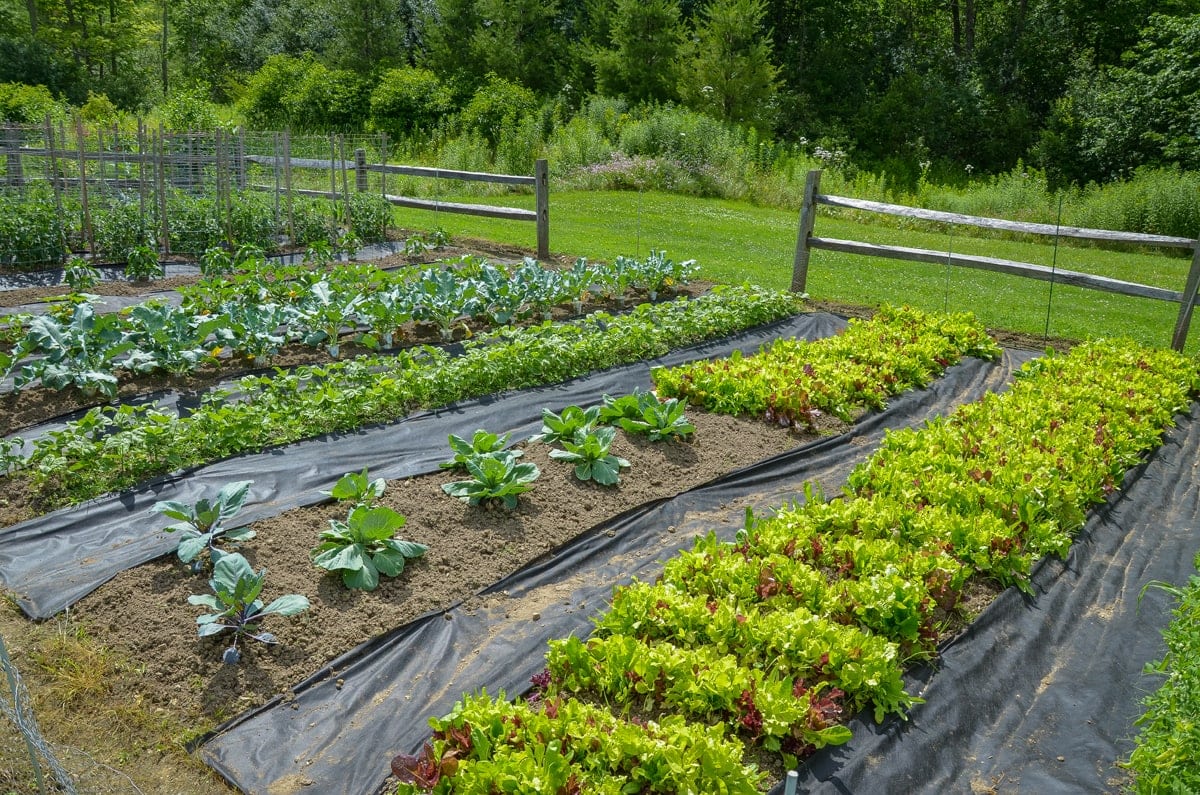
Hildene’s productive kitchen garden
.
The vegetable garden looks nicely productive, but the practical side of me noted its long distance from the main house, clearly not very convenient for popping out to get for a lettuce for lunch.
Everything about Hildene reminds us that it required a commensurately large staff to support daily life on the estate.
The Northshire garden
After visiting Hildene, the Northshire garden behind the bookstore, created a few years ago by Carrie Chalmers, will come as a complete contrast.
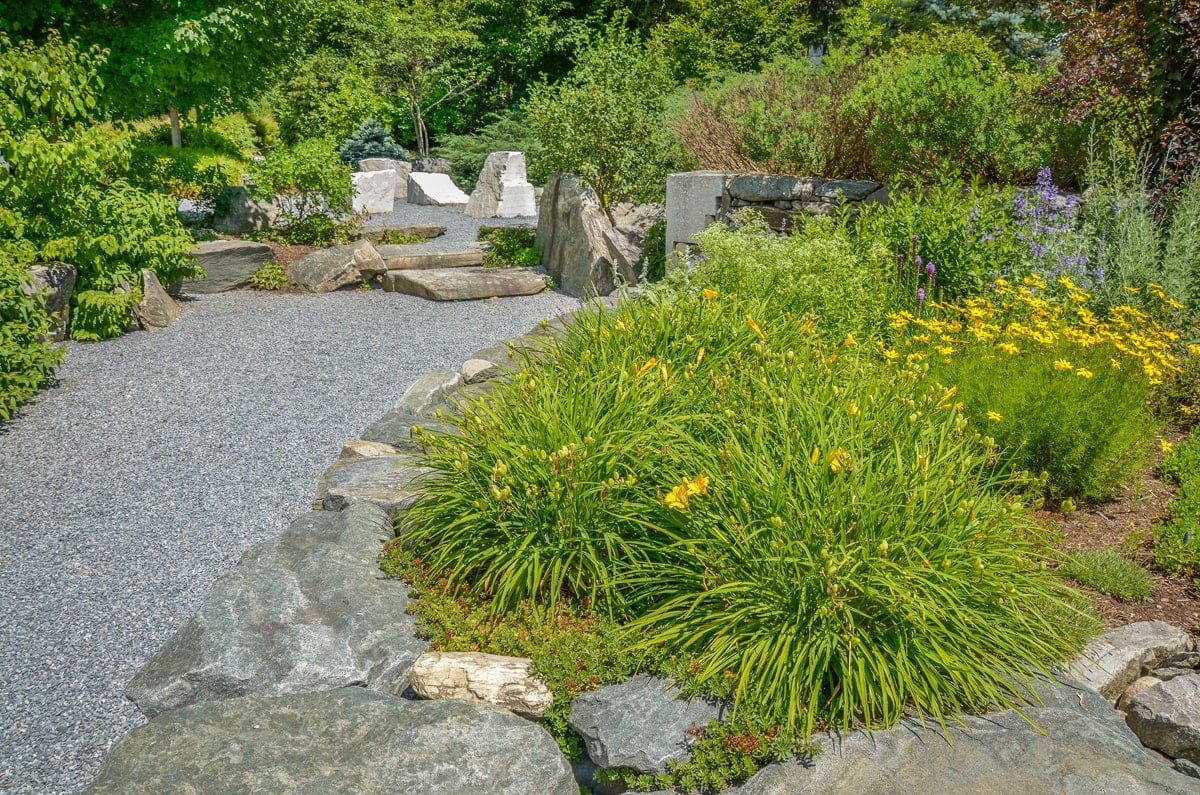
Flowing lines characterize the garden behind the Northshire bookstore
This is an intimate garden, sandwiched next to a parking lot, where people can stroll around, perhaps stopping awhile to read or chat. And here the upkeep, though not negligible, is vastly less than that needed at Hildene.
The space incorporates two levels, a narrow upper level and a more expansive lower level, separated by an long stone retaining wall and connecting steps.
More than ‘just plants’

Crushed bluestone in place of a lawn at the Northshire’s garden
The first thing you notice is the absence of lawn. Yes—gardens do not need lawns to be complete!! Instead finely crushed bluestone is used to create the walking space (or negative space) throughout the lower level.

The masterful stonework is a delight
The second thing you notice is the stunning stonework and complex spatial layout that makes up the core of the garden, demonstrating that gardens are much more than the sum of their plants!
The irregular spatial layout of the lower level serves to hold our interest and offer new surprises as we stroll around the beds to admire the flowers. A beautiful blue metal butterfly and island stones complete the picture.
Easy planting schemes
From the main lower level, cast you eyes upwards to admire the interesting mix of overhanging shrubs along the upper level. There are shrubs towards the rear of the lower level too, including some evergreen spreading yew and a small upright spruce.
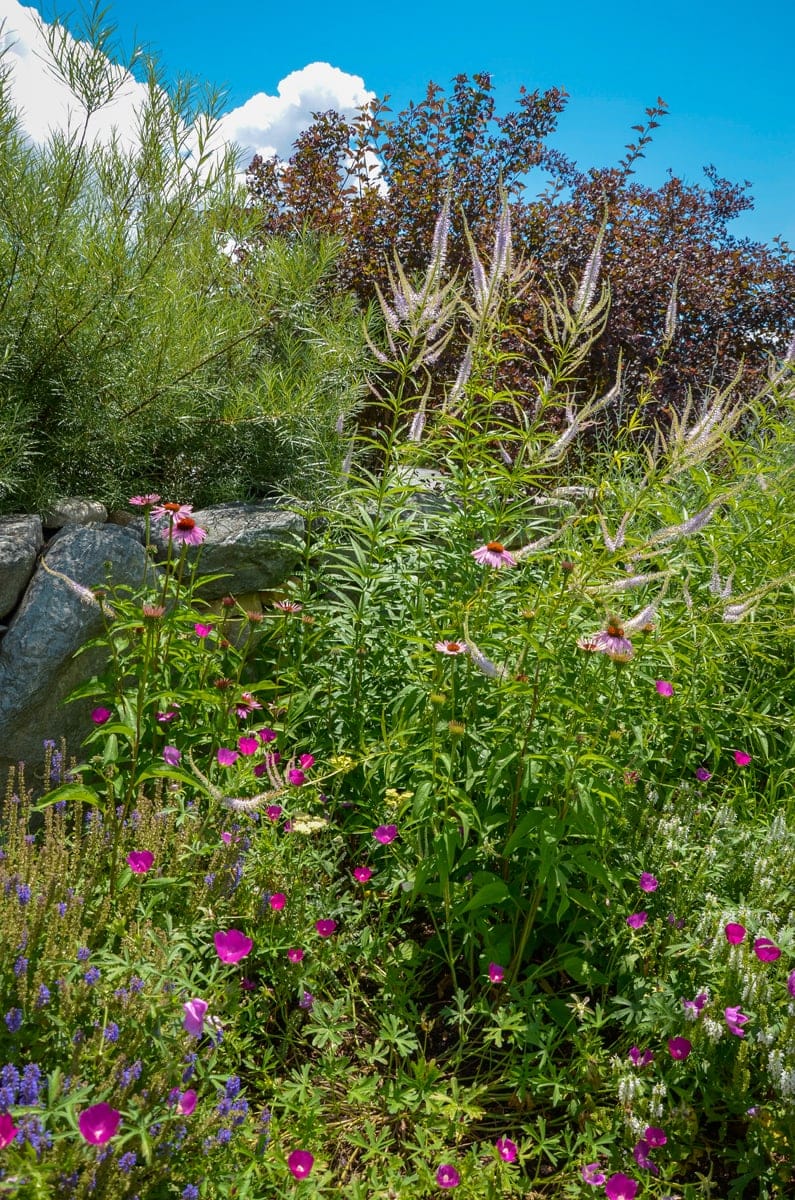
Callirhoe involucrata ‘Winecup’, Veronicrastum and Physocarpus ‘Diablo’
And not all the shrubs in the garden are green; for instance a group of Physocarpus ‘Diablo’ on the upper level creates a bronzy focal point from May till October.
The flower beds on the lower level are all sightly elevated, a nice touch that brings everything closer. They are edged with substantial stone walls and flat capstones that create extended seating areas. And since all the plants in these beds were thriving in mid-summer presumably plenty of good-quality top-soil mixed with compost was brought in at the outset.
The flowerbeds are filled with easy-care perennials of contrasting shapes, such as the tall spikes of Veronicratstrum and shorter spikes of Salvia and Nepeta, versus the daisy-like flowers of Leucanthemum and Coreopsis. And the magenta poppy mallow, Callirhoe involucrata, makes a brilliant splash as it weaves between its taller companions.
And finally, clumps of tall grasses, used to create a visual barrier with the parking lot, are a nice way to avoid interfering with snow removal in the winter.
Vive la difference
Two gardens a century apart; so what do they tell us about our gardening ideals?
Here are some of my conclusions:
Modern gardens are made to be lived in, rather than seen from afar.
Nowadays we care less about formality, both in our lives and in our gardens.
Contemporary gardeners favor designs that will be easy to maintain.
Today we use shrubs for continuity and perennials for spontaneity.