Late Winter Pruning
Cabin fever hits us all in late winter; after months of indoor living we find ourselves yearning for spring, and we can surely be forgiven for grumbling about heavy wet snow in March.
Wikipedia describes cabin fever as ‘a claustrophobic reaction from being confined in a small space for an extended period of time, resulting in extreme irritability and restlessness, often accompanied by an urge to go outside, even in rain, snow, dark or hail’. I certainly understand the urge to get outdoors, but I prefer to skip the rain, dark and hail.
And, as a therapy, it cites a scientific study that shows simply getting outside and interacting with nature will improve both your cognitive abilities and your sense of well-being. But this is probably something you intuitively knew already.
Late winter: the perfect time for pruning

Seven Son Flower, Heptacodium miconiodes, needs pruning often to remove suckers. But I love its bark in winter.
So, if you are a gardener beset by cabin fever, may I suggest the perfect antidote: unearth your pruning saw, sharpen your clippers, and get going on some late winter pruning.
Even though we humans are now eagerly anticipating spring, most of our trees and shrubs are still fully dormant, making late winter an excellent time for pruning. Pruning stimulates new growth that will kick into high gear the moment spring arrives. And without its leaves, the structure of the plant is readily apparent, making pruning that much easier for the gardener.
Pruning is the removal of any part of a plant to promote plant health and a desirable growth form. And it certainly covers a host of specialized goals and techniques, from training young trees for long-term structure and pruning to enhance fruit production, to creating bonsai.
However the goal of my late winter pruning is simply to ensure my existing shrubs and small trees continue to thrive and look great in the garden. And the techniques are not difficult.
Easy does it
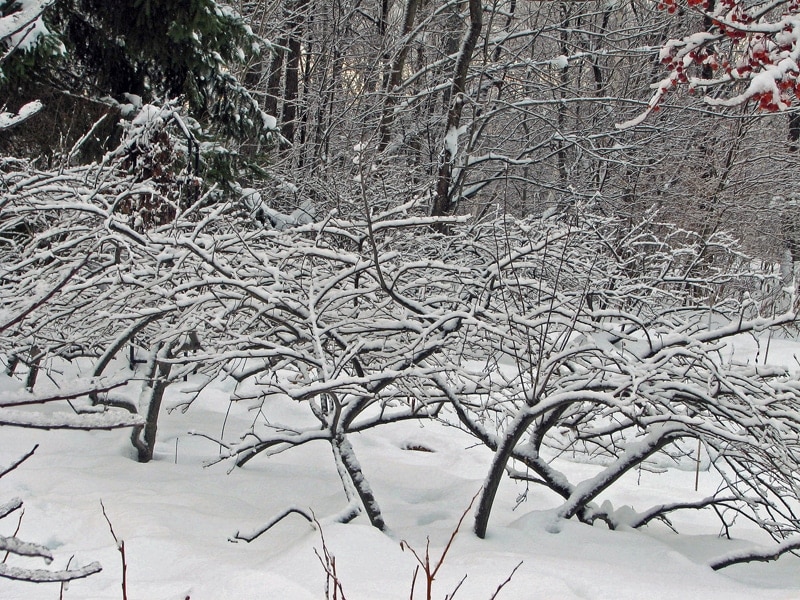
By February the birds have eaten all the fruit on my winterberries (Ilex verticillata) but I still enjoy the shapes of the dark branches against the snow. Every couple of years I spend an afternoon removing the small lower branches to keep the bushes tidy.
I work with one plant at a time, and before making a single cut, I stand back and examine it carefully. I look for old or diseased wood, and analyze whether the interior looks cluttered.
With my first cuts I remove all the branches that are dead, diseased or really old, each time cutting all the way back to a strong live branch, or in the case of suckering shrubs, right to the ground. These are called thinning cuts. When making a thinning cut it is important not to leave a protruding stub; it will eventually die and in the meantime it creates an entryway for disease. Furthermore it looks ugly!
At the same time take care not to cut too close the parent branch. Locate the ‘branch collar’, the ridge of bark at the junction between the side branch and the trunk, which is an active growth site. By making your cut just outside the branch collar new bark will quickly grow over and heal the wound.
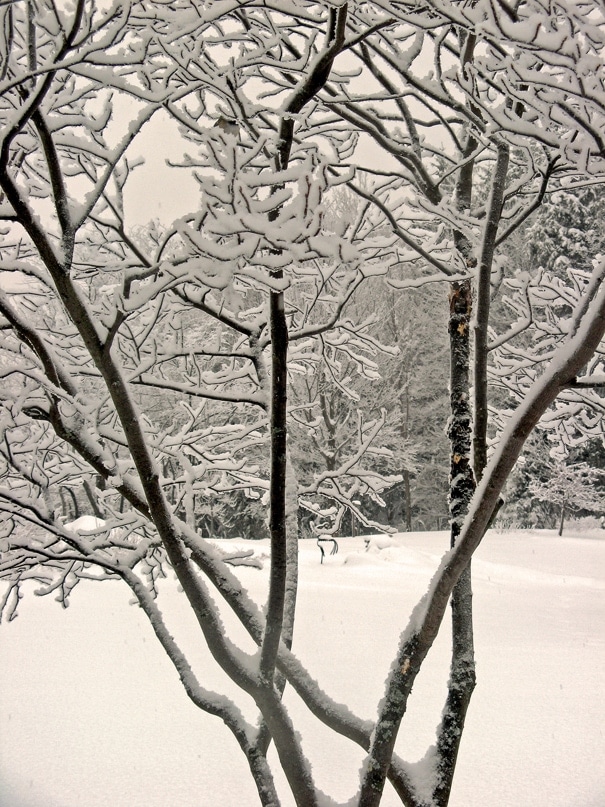
A serviceberry (Amelanchier canadensis) has been pruned to give a clean uncluttered interior
Next I look for branches that are rubbing their neighbors, or will become that way in another year or two. Rubbing branches also create entry points for disease, and their contrary directions spoil the aesthetics of the plant. So, for the good of the whole, I will sacrifice one.
I now stand back again, and contemplate whether, by removing a few healthy branches, I could achieve a less cluttered interior. However I am careful not to overplay my hand. To ensure the plant continues to manufacture sufficient food, two-thirds of the leaf-bearing surfaces need to remain after pruning.
Finally I look to see whether the plant would look better if it were slightly more compact. If the answer is ‘yes’ I trim back the outermost branches, using what are known as heading cuts, made across the twig just above robust outward-growing buds. These buds will become new growth points in the coming season. So, before cutting, I pause to visualize how the plant will look, a year or two from now, when the buds have grown into new twigs or even complete branches.
What not to do

Over several winters this large wild apple tree has gradually been revitalized by careful pruning
Pruning large trees is always best left for an expert. However, even when you call in somebody else, it is extremely helpful if you can visualize the desired results—after all it’s your garden!
A case in point: I have been working over several seasons with Fred Schroeder of Bristol, who specializes in apple tree pruning. With careful pruning he has gradually rejuvenated the wild apple tree you see pictured here. But he involves me in all the major decisions of how much to remove and what to trim.

An old lilac bush arches over our ‘Spirit Keeper’. This pruning job was postponed until after bloom-time and spread across several consecutive years.
And some pruning jobs are best postponed till later:
- In late winter the sap is running full bore in our maple and birch trees, and pruning causes excessive bleeding. Prune them during the summer or in early winter.
- Spring flowering shrubs, like azaleas and lilacs, set their flower buds the previous summer. To avoid sacrificing any blooms, prune them within a month of flowering.
- Conifers are best pruned after the first flush of new spring growth.
- Roses should be pruned when the first green buds emerge in spring, when you can easily see and remove any winter die-back.
A visit to a nursery
I love pruning and am always eager to learn more. So, back in March 2012, I joined a group of professionals for a pruning workshop at the South Forty nursery in Shelburne, where they raise field-grown ornamental trees and flowering shrubs. While South Forty is a wholesale operation, you can find high-quality locally grown plants, including theirs, at local garden centers. Look for the white label with green lettering telling you this is a ‘Vermont Grown’ plant.
Since January South Forty’s arborist, VJ Comai, has been out every day pruning his neat rows of young plants, and by the time or our visit he had nearly completed his entire stock.

This crab apple has a strong scaffold of outward facing branches. It is pruned every two years using thinning cuts to maintain an open interior.
He demonstrated for us his technique for pruning a five-year-old crab apple. Using thinning cuts, he quickly skimmed the entire upper surface of each main branch, removing all the small internal branches at the precise spot where they joined the parent.
He then turned his attention to the tree’s outer branches. Young trees make extensive annual growth at the branch ends which, left unchecked, will result in an ungainly tree. So, using heading cuts, VJ removed half or more of the previous season’s growth, making each cut at an outward facing bud.
The result was a beautifully shaped tree destined for a lucky gardener. We all then repaired to VJ’s sugaring operation, to warm up and watch as he recycled pruning wood into fuel.
To learn more…
…pick up a copy of ‘Pruning Made Easy’ by Lewis Hill ((Story Publishing). This classic book on pruning by a well-known Vermont author has clear instructions and great illustrations.