A head-start on spring
Gardens are built on the past. In large part, the garden we enjoy today is determined by what we did months or even years ago. And likewise:
what we do in the garden today sets the table for the garden of the tomorrow.
With this in mind I would like to suggest that:
Late fall is the perfect time to ready your kitchen garden for spring.
I well know that if I miss this opportunity in October and November, I must wait until the ground is both unfrozen and warm enough to work in spring…usually about mid-May in the mountains.
And, come May, all too often I find reality thwarts my best intentions.
In Vermont the weather in May can be quite chilly, sometimes raining for days on end. And on the days when the sun is out I am off helping clients with THEIR gardens. So by the time June arrives all the weeds are growing mightily and definitely winning the war.
Last fall (2010) we were blessed with a long spell of mild weather that lasted until Thanksgiving, and to my great satisfaction I was able to prepare my entire vegetable garden.
And this past summer (2011) my efforts were rewarded with the most wonderfully productive and essentially weed-free garden.
My ‘fall clean-up recipe’ for the kitchen garden
In my four-square kitchen garden I like to work on one bed at a time. I always start with the four center beds where I will be growing my annual crops. As time permits I move on to the perimeter bed and maybe even prune the fruit bushes while I am at it.
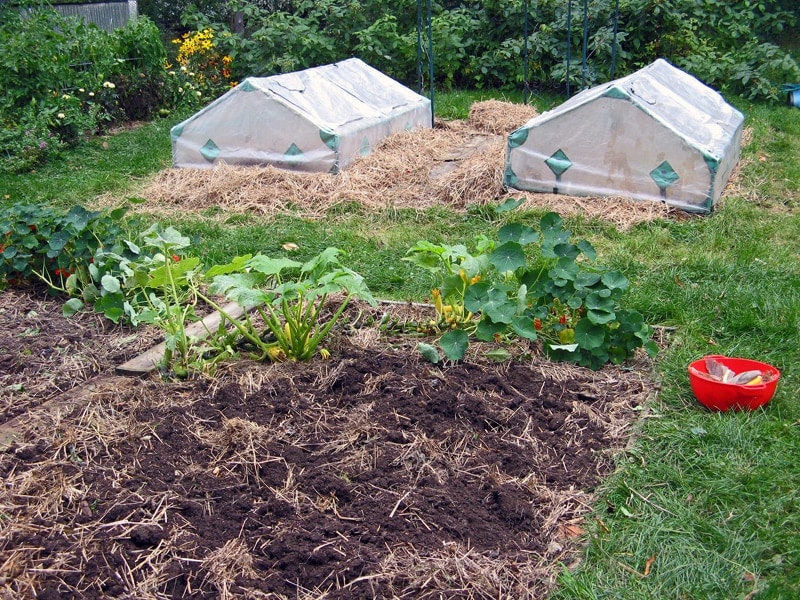
Early October: The back bed, iwith a hay mulch in place, is all set for winter. Thre is spinach in the coldframes, which should yield an early spring crop.
Here is my recipe. And what you don’t complete this fall can be finished off next spring.
Gather your ingredients:
- Compost (from your compost pile or elsewhere), reasonably well aged and mixed
- A big stack of old newspapers (NO colored sections)
- Mulch hay…I find 8 bales of hay will cover my four center beds (approximately 500 square feet)
And follow these simple steps:
- Cut and remove any ANNUAL weeds that are setting seed. (You can leave any that do not have seed heads)
- Remove ALL PERENNIAL weeds…dandelions, field grasses and the like. Do this carefully, being sure to get out the whole root system; otherwise next summer the offending weed will surely return to haunt you.
- Spread up to four inches of compost over the whole surface of the bed.
- Using a garden fork, gently incorporate the compost into the top few inches of soil and rake it smooth.
- Cover the whole bed with six layers of newspaper…overlapping the sections somewhat. If you use boards for a path, tuck the newspaper under them too. If the wind insists on blowing the newspaper about, douse it with water to keep it in place.
- Cover the bed with several inches of hay .
Hay as mulch??
Hay is readily available from the farms around here and many of us use it as a mulch for our veggie gardens. But I do like to check that hay I am getting was cut young enough so that it does not contain visible seed heads from field grasses or other undesirables.
Why the newspaper??
The purpose of the newsprint, which will still be reasonably intact next summer, is to keep the LIGHT away from the soil and prevent the ANNUAL weed seeds that live in the soil from germinating.
Next spring: reap the benefits!
If you follow this late fall ritual, a bed can sit without any further attention until YOU are ready to plant it out. No more worrying about the race against time and the weeds.
Select the time that is just right for any particular crop…. for instance: peas in April, salad greens and spinach in early May, beans, tomatoes and squash on Memorial Day!
To plant individual seedlings: where you will be planting just pull the hay back a little, cut a hole through the newspaper and plop your seedling into the nice fluffy soil beneath. Water well and reposition the mulch around it.
To plant a row of seeds: first pull the hay back a few inches along the entire length of the row. Now cut a slot in the newspaper and plant your seeds.
For the heat-lovers: If you are concerned that the mulch is preventing the soil from warming up enough for crops like tomatoes, just pull the entire mulch sandwich to one side for a week or so to expose the soil to the sun. After you actually get around to planting, pull everything all back around your plants to stop the annual weeds from getting a foothold.
What could be easier??!!