Dancing grasses
Simple gifts
Watching the wind ripple through a field of grass in the warm glow of the evening sun is pure magic.
Likewise in the garden, when the delicate stems of eye-high grasses catch the sun and wind, this is one of the September garden’s simple gifts.
Movement is magic.
Grasses: queens of the fall garden
Grasses give the garden a new face in the waning season. In September, just as many perennials are calling it quits for the year, grasses are reaching their full glory. It is a special sight indeed to see the purple flower heads on the Maiden Grass positively glowing in the low autumn sun as they sway gently in the breeze.
For the last several years in the informal meadow garden of our ‘pond bed’ I have been experimenting with different types of hardy ornamental grasses.
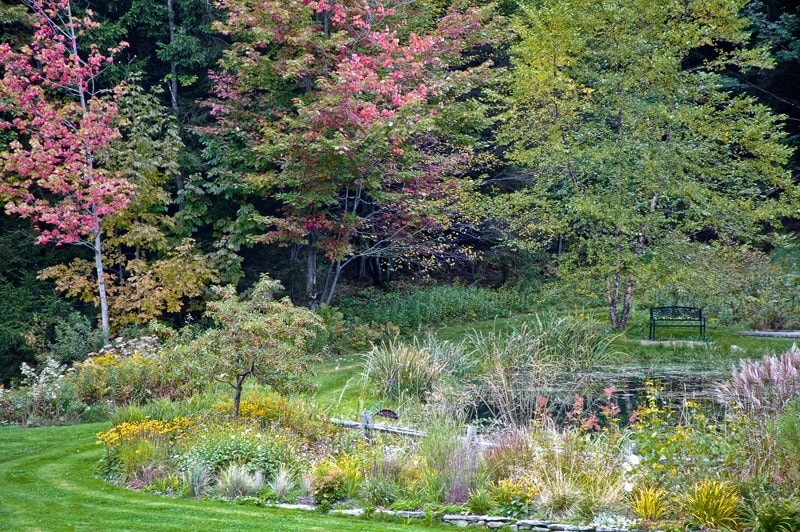
Here, in this rough-and-tumble environment adjacent to the pond, I have established an eclectic mix of tall flowering grasses and sturdy perennials (Daylilies, Meadowsweet, Siberian iris, Rudbeckia and the like).
I have grasses growing in other more tidy parts of the garden too, where I like to situate them in places where they will get cross-lit by the early morning or late afternoon sun.
Here are some great grasses for cold climates that I grow in here my Vermont garden, which catch the breeze and make a little magic.
Double click on any picture to see it enlarged.
Purple Moor Grass

Purple Moor Grass (Molinia arundinacea ‘Skyracer’) is an especial favorite. Its soft arching leaves make three foot high mounds, above which the most slender stems and delicate flowers—six foot or more— imaginable trap the raindrops and dance in the wind.
I love to watch as a song sparrow clings to single stems of the moor grass…which must be a lot stronger than it looks… to feast on the seeds!

Raindrops shine like little diamonds in the Purple Moor grass
Some years back I started out with a single plant of Molinia. It is now a grouping of five plants outside our bedroom window where the dainty flowers hold the smallest raindrops and positively shimmer in the morning sun.
The leaves turn a nice yellow in the fall but, alas, I know they will succumb with the first heavy snow.

Purple Moor grass with Blue Oat Grass in front
Short and Blue
If you want leaves other than green, try one or both of the familiar short blue grasses: Blue Oat Grass, (Helictotrichon sempervirens) and Blue Fescue (Festuca glauca ‘Elijah Blue’). Both fit nicely at the front of the border, where their blue-gray leaves will be a constant presence no matter what the season.
Their flowers arrive earlier than most of our garden grasses. So come June and July you will be mesmerized by the movement of their taller floaty flowers. However by mid- August the flower stalks, having achieved their mission, will start to disintegrate. At this point I cut them down, leaving the familiar blue spiky mounds to grace the garden in fall and winter.
For a great fall look I have combined Blue Oat Grass with the buttery yellow hardy mum ‘Mary Stoker’ and the rosy pink of Sedum Autumn Joy Sedum…a perfectly matched trio.
Feather Reed Grass

Feather Reed Grasses stand out tall and straight, among the perennials and shrubs of the September garden
Feather Reed Grass (Calamagrostis ‘Karl Foerster’), widely planted and its straight vertical look, is readily recognized. On a windless day a group of Feather Reed Grass looks stiff and soldier-straight, but even the gentlest breeze brings a graceful movement to an otherwise static scene. And extra nice: the effect lasts for a full six months, from June through November.
A while back I found a variegated form called ‘Avalanche’ seen here with some Rudbeckia, which makes it a a little more interesting.

The Feather Reed cultivar ‘Avalanche’ sports a white stripe in its leaves
Tussock Grass
Tussock grass (Deschampsia cespitosa) forms 18 inch high soft hillocks of green that also make a nice edging for the front of the bed. Then suddenly, around in mid-summer thin stems and flowers pop up, creating a translucent undulating curtain which looks stunning when back-lit by the afternoon sun.
Maiden Grass

Maiden grass with the tall Rudbeckia ‘Herbstronne’ and a pair of Tussock Grasses in front
The ever-popular Maiden grass (Miscanthus chinensis) is a useful, well-known and extremely reliable grass.
There are lots of cultivars available on the market, including ones with wispy leaves and stripy leaves…take your pick. I have the cultivar ‘Malepartus’, which in September is topped with gorgeous six-foot high flowers, like plum-colored feathers. Even though these seem heavy in texture they too respond beautifully to the wind. And come next March they will still be around…but by then they will have turned a parchment color that looks most elegant against the snow.
Shenandoah Switch Grass
The switch grass ( Panicum virgatum) cultivar ‘Shenandoah’ is especially lovely in the fall. Its graceful fine-textured flowers maturingin September, just as its leaves turn a striking bronze color that is visible in our pond bed all the way from the house… about 50 yards away.
Little Bluestem and Big Bluestem
Little Bluestem (Schizachyrium scoparuim) and Big Bluestem (Andropopon gerardii) are clumping prairie grasses, and they are both delightful in an informal meadow planting. The flowers start in mid-summer and are attractive, but by September the seed-heads are complemented by a purple coloration in their leaves which is lovely.
And just this year I acquired a single plant of the incredibly blue Schizachyrium ‘The Blues’. It is certainly been true to its name, a beautiful blue all summer and just now in September turning a stunning reddish purple. I will be dividing it soon to make a small colony of them.
Using grasses in the garden
Here are some suggestions for using garden grasses to the best effect:
Know your space
Even the smallest garden has room for a few grasses— perhaps a group of slender Feather Reed Grasses or a some clumps of Blue Oat Grass.
But a stand of a towering Miscanthus or a cluster of Purple Moor Grass will be right in scale in an expansive country garden.
Mix and match
The fine slender stems of grasses combine beautifully with the contrasting texture of easygoing perennials like Daylilies and Rudbeckia, Shasta Daisies and Kansas gayfeather, Purple Cone Flowers and Siberian iris.
Site grasses to catch the light
As you decide where to plant them, remember that all grasses show off best when lit, either from behind or from the side, by the low sun, either in the morning or evening.
Enjoy grasses all winter long
Most, but not all, grasses remain relatively unscathed through the long snowy winter months ahead. Their skeletons, etched by the frost, look positively ghostly. So experiment with leaving garden grasses standing until spring before consigning them to the compost heap.