Grande Finale
“Autumn, the year’s last, loveliest smile”
William Cullen Bryant (1794 – 1878)
One day in early September a friend remarked “Well, I suppose your garden is all gone by now”.
Not at all!! While the exuberance of summer may be past, in its own way the garden in autumn is every bit as lovely. Summer stalwarts– like Shasta daisies and Echinacea— may be past their prime. But others…like rudbeckia, sedums, anemones and asters—are just coming into their own. The colors of our flowers are more mellow in autumn, in harmony with the tawny colors in the forest around us.
Of course it is that way all through the year. As early flowers fade, others enter the spotlight. Flowers are like actors waiting for their cues to take center stage for a few weeks of glory.
Autumn belongs to perennials like rosy sedums, golden Rudbeckias, lavender Asters…and more! And they will flower until the middle of October, even though the time remaining for them to get fertilized and set seed before the cold weather seems impossibly short! Now it is the first week of October, and the asters are still abuzz with the humming of late season bees, so clearly pollination is happening!!
Here, in no particular order, are six great perennials plus a noteworthy annual for the fall garden. Double click on any picture to see an enlargement.
Black-Eyed Susans

It works well to combine black-eyed Susans with a contrasting flower…as here with the white Hydrangea ‘Tardiva’
Everyone is familiar with Black Eyed Susans, Rudbeckia fulgida, and, like everyone else, I have lots in my garden. When we moved to Vermont back in 1994 I brought a couple of plants of the supposedly more floriferous cultivar Goldsturm from my old garden, which I had purchased from White Flower Farms around 1990.
Now there are enormous patches of sunny gold daisies all around the place. They began blooming in early August and two months later they are only just now losing their petals. They are pest-free and they flourish in part shade as well as full sun. What more could one ask?

The tall Rudbeckia looks good with fall grasses, such as this Miscanthus ‘Malepartus’
From a design perspective the gold of Black-eyed Susans sometimes seems a bit brash. So I like to pair them up with other flowers, such as purple or lavender asters, or set in front of a fall hydrangea Tardiva as in the picture above.
I also love the their much taller cousin…the six foot high Rudbeckia ‘Herbstronne’. This is one big plant that makes a bold statement, but even even in the smallest garden there is probably a place for it.
And resist any temptation to cut and compost either rudbeckia at this time of year. If you leave them standing through the winter their skeletons will look lovely against the snow and the seed-heads provide winter food for the chickadees and goldfinch who, miraculously, remain with us throughout the winter.
Japanese Anemones

The Grapeleaf Japenese Anemone
Japanese anemones have a charming way of weaving themselves among shrubs and sometimes popping up in the most unexpected places. In my New Jersey garden they could be a little too rambunctious, but here in Vermont, towards the edge of their hardiness range, they behave beautifully.

The Grapeleaf Anemone looks splendid weaving its way around the Purple-leaved Smokebush ‘Grace’
I have two kinds in my Vermont garden.
The single pink Grapeleaf Anemone, (A. tomentosa ‘Robustissima’) starts to flower in August, and looks spectacular against the dusky colored leaves of the smokebush cultivar Cotinus‘Grace’.

The white Japanese anemone ‘Honorine Jobert’
And then there is a pure white hybrid, (A. Honorine ‘Jobert’) which is a real standout next to a large blue pot on our shady barn slope.
However I feel very white flowers of the Honorine Jobert Anemone would look nicer without having to compete with the creamy white flowers of the Canadian Burnett. So in November I plan to replace it with the pink flowered Japanese Burnet, and relocate the Canadian burnet to the pond bed. Musical chairs…it seems there there will always be a few things in the garden that need modifying to get the best effect.
Sedums
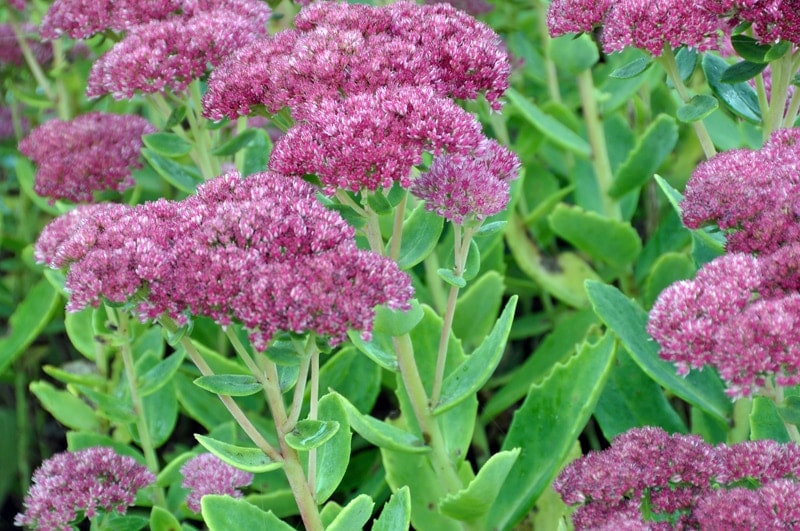
Autumn Joy Sedum may be common but nevertheless a wonderful garden plant.
Sedum ‘Autumn Joy’ is a delightful and dependable old stand-by, and every garden could use some. In the summer months it has interesting leaves, in September its flat rosy-pink flower heads are a standout, eventually morphing to a bronze color in October. And finally in the winter the spent flower-heads of Sedum ‘Autumn Joy’ look great under little hats of snow.
There are also some smaller sedums that wait until September to flower…in my garden most notably Sedum cauticola, which has crimson pink flowers against gray leaves, and faces off a group of the amazing annual (but self-seeding) Salvia hominium. Everybody who comes to the garden at this time of year raves about both plants.
Asters

The Aromatic Aster ‘October Skies’ looks perfect with “Royal Purple’ smokebush
By the time the asters put on their show we know the season is coming to a close. I love the wild asters that grow around here, in open fields and in swampy areas, and even in the woods. They come in colors of white, lilac and lavender, with names such as Heart-leaved Aster, Flat-topped Aster and Purple-stemmed Aster. And at lower altitudes even from the windows of your car you can spot the well-known New England Aster, with its larger, deeper colored flower, growing along at the side of the road.
According to Wikipedia all our ‘New World’ Asters are about to be be reclassified into a different genus called Symphyotrichum, which seems like a horrible mouthful. So, for the time being at least, I will continue to call them all Asters!
For many years in the garden I have grown a number of cultivars of our native New England Aster. I am especially fond of the dwarf cultivar ‘Purple Dome’ near the front of the bed.

The Italian aster is a great addition to the fall garden
But I am gradually switching my negligence to some of the other species of the Aster clan. For me, New England Asters have two problems. Typically the leaves on their thick lower stems shrivel to brown as the flowers are starting, resulting in ‘ugly legs’ which I attempt to camouflage with Black-eyed Susans. I also find, with our shortened growing season at this altitude, that cultivars like Harringtons Pink, Hella Lacy and Alma Potschke’ are coming into flower just as the frost is shuttering the garden down, and therefore not worth the space I had accorded them on the garden.
This coming November, when I do my post-fall garden clean-up, I am resolved to completely remove all the new England Aster ‘Harrington’s Pink’, replacing it with the Canadian Burnet from the barn slope. ‘Harrington’s Pink’ was a small plant that I purchased some years back which it has now grown into an enormous clump in the pond bed, but it rewards me with… at best… a week ‘s worth of flowers in mid-October. It is not worth the space!
I am very fond of some European Asters, Aster amellus (which I grew from seed in a mix of colors a few years back) as well as the dwarf New England Aster cultivar ‘Woods Purple’. And I have recently added Aster oblongifolius ‘October Skies’ to my fall garden mix. It is a beautiful delicate lilac color, starting about the third week in September. And I also have several clumps of the wild heart-leaved aster I find growing in the meadows around here.
Geranium ‘Rozanne’

The geranium ‘Rozanne’ looks good with a yellow heather
Rozanne is not just any old geranium. In my gardening world she is one small miracle!
I think of geraniums as early summer flowers, and very useful plants they are for that. But Rozanne is unique among geraniums. In my garden she only really gets going in July… but once started she flowers non-stop until cut down in mid-October by the first heavy frost. She also keeps spreading outwards, so by the time September comes, a single plant is making quite a statement in the garden.
Rozanne also has an interesting history. About 20 years ago Donald and Rozanne Waterer noticed some interesting and long-flowering geraniums in their garden in Somerset, England. From these plants, Alan Bloom, owner of ‘Blooms of Bressingham, developed the patented Rozanne hybrid via tissue culture, and introduced her to the plant world in 2000.
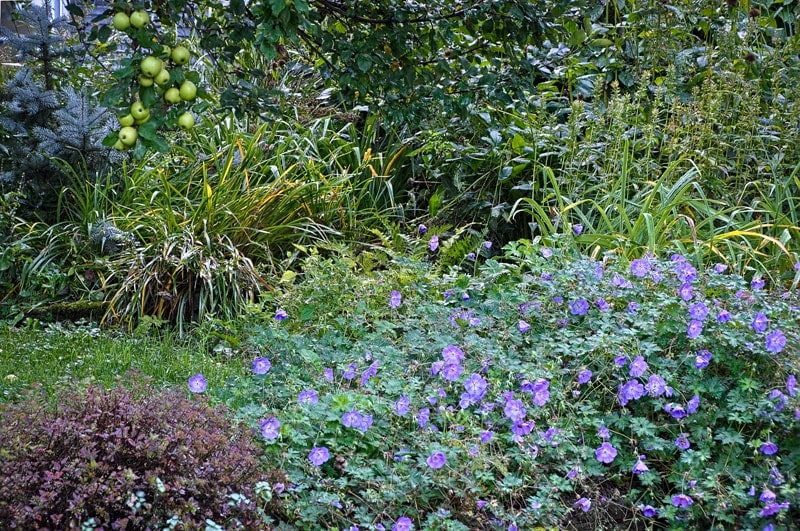
Geranium ‘Rozanne’ with the apples of fall
Listed as hardy to Zone 5, I was skeptical that I could grow Rozanne successfully in my Zone 4 garden. But I acquired three plants that have all come through multiple winters. And despite that really cold snap last winter (when the temperature here dropped to -25℉) my plants have done better than ever this year. But then again, perhaps that was because they were so well protected under last winter’s excellent snow-cover. Anyway I am delighted to have this violet-blue flowered geranium gracing my garden again this fall.
Chrysanthemums

The hardy ‘mum’ Mary Stoker’ contrasts nicely with dwarf evergreens
Hardy ‘mums’ help north country gardeners finish the gardening year in style. While most so-called ‘hardy mums’ …the double-flowered types you buy at the garden center at this time of year…will not prove hardy in our climate, I can vouch for two of the single daisy types of chrysanthemums as true perennials in my Vermont garden.
The Chrysanthemum ‘Clara Curtis’, with rosy-pink flowers and yellow centers, blooms first. She is quite pretty and very easy to grow, but tends to flop a bit. Every fall I tell myself that, come next spring, I will create an elegant bamboo frame to support her…. but that has yet to happen.
The second ‘mum’ I grow is Chrysanthemum ‘Mary Stoker’. While this one waits until in mid-September before coming into flower, she will still be gracing the garden in mid-October. Mary Stoker is a pretty buttery-yellow and always stands perfectly upright, even in winter.
And finally…an annual salvia that blends with our autumn colors

It is late September in this picture. Marble Arch salvias and Rozanne geranium are still going strong, and the blueberry bushes are starting to turn bronze.
Visitors to my garden invariably ask ‘What is that lovely plant?’ as they admire the purple and pink colors of my Marble Arch Salvia, Salvia hominium, which flowers from July to October
They are usually quite surprised when I tell them is an annual, since most people think annual salvias will be fire-engine red.
However the Marble Arch mix is different. The attractive bracts come in colors pinks, purples and sometimes a greenish white, with interesting veining that makes them delightful to see up close too.
It is quite easy to grow from seed. And what is more it usually obligingly self seeds in the garden. So, providing I am not too careless with my spring weeding, plants will re-appear next year, behaving for the gardener almost like a perennial!
Don’t say its over
This is the first week of October and the garden has that typical fall look…the blueberry bushes have a wonderful bronze color, the sweet autumn clematis on the arch is in full flower, and still the aromatic asters, Autumn Joy sedum, the Marble Arch salvia, Rozanne geranium and Mary Stoker ‘mums’ are flowering like there is no tomorrow.
As with life, it is up to us to enjoy the garden in every season!