An inquisitive loving journey
A garden should be in a constant state of fluid change, expansion, experiment, adventure; above all it should be an inquisitive, loving and self-critical journey on the part of its owner.
H.E.Bates
As all gardeners know, a garden is not a static ‘thing’ that you plant once and expect it to stay the same. A garden is an artistic creation, but one that is always changing and always evolving, most obviously from season to season and also, perhaps a little more subtly, as the years roll by. Time is like the fourth dimension of the garden.
A garden is also more than just a collection of individual plants; it is a living organic whole. And, like any living thing, to keep it healthy and vibrant, the garden will need a little attention from its gardener.
Whatever others may say, there no such thing as a ‘maintenance-free’ garden.
Ages and stages in the garden
Early years
As with a child, it is the early years of a garden that demand the most attention from its caretaker.
Spacing for maturity means gaps when young
To avoid a pruning maintenance nightmare in the future, it is important to space trees and shrubs with an eye to their eventual size, which can vary immensely. And most woody plants are also hard (i.e. next to impossible) to move when they are fully grown. So at the outset it works best to space them for the long term.

Young shrubs spaced with an eye to the future
However, when we get them as youngsters from the nursery they will be quite small. Thus inevitably, in the early years, there will a fair amount of space between them and regular weeding is critical. A light covering of bark mulch is invaluable to keep the weeds at bay but, all too often, results in that depressing ‘sea of mulch’ look so characteristic of a young garden.
Solving the ‘sea of mulch’ problem
At the outset establish a low growing groundcover around the shrubs. I often use Geranium macrorrhizum ‘Album’ which is a strong grower but, if it expands too far, is relatively easy to remove.

Early days always mean mulch
Then fill all the remaining spaces between the young shrubs with perennials. As the shrubs enlarge it will be relatively easy to relocate perennials like Daylilies (Hemerocallis) Purple Cone Flowers (Echinacea purpurea), Shasta Daisies (Leucanthemum ‘Becky” and Black Eyed Susans (Rudbeckia Goldstrum).
Another practical approach is to make the entire bed smaller at the outset, just large enough for the shrubs and a few perennials. Then, as the shrubs grow in, expand the bed outwards and move some of the perennials into the newly prepared outer portion.
Gentle pruning
During these early years it also helps to gently prune the shrubs and trees so that they will achieve an attractive form as they grow.
Peak of perfection

In the same bed a few years later the perennials create a tight matrix of color and texture
Little by little the garden reaches its peak of perfection with everything in balance and a fluid tapestry of color and texture that dances through the season.
As the plants enlarge, they shade the soil naturally. This reduces the opportunity for weeds seeds to germinate and also hides the sea of mulch.
With few demands on the gardener beyond light weeding in springtime, this is a wonderful time to savor and enjoy your handiwork and even extend an invitation to the local garden club to visit.
Editing and tweaking
But, if you want your garden to stay looking fresh and vibrant as it matures, sooner or later you will need to do some editing and tweaking

In June 2005 the ‘William Baffin’ rose was a dominate presence in the garden
Slowly but surely, as the trees and shrubs expand, the patterns of sun and shade reshape themselves. At this point you should rescue any sun-loving plants and relocate them into more open parts of the garden.
Also, even with the most careful planning, perennials sometimes outgrow their spaces or weeds creep in, making everything seen overly full and messy.
At the other extreme, fussy plants may prove to be short-lived, leaving holes to be filled.
Occasionally even a seemingly robust plant dies back for not apparent reason. In 2005, when the picture on the right was taken, our Rosa ‘William Baffin was thriving beautifully, only to die back a few years later.

After the demise of the rose I planted the vigorous Sweet Autumn Clematis
So I replaced it with some Sweet Autumn Clematis, Clematis ternifolia, a sturdy plant you can see on the left that is holding its own beside the vigorous Kerria japonica ‘Picta’.
Over the summer, take a long hard look at everything with a critical eye. Then in the fall, after perennials have gone dormant, you can lift and divide them, either returning them to the bed or replanting themelsewhere in the garden. Any excess make nice gifts for other gardeners who may be starting out with empty beds.
One garden’s ebb and flow
As an example of the natural ebb and flow of the garden I would like to share the story of our gazebo garden.
Back in 2000 we decided a gazebo would be a perfect bug-free place to enjoy our long Vermont summer evenings. This 12 foot square screened building is set on a diagonal to the rest of the property. It is backed by a large garden bed some thirty feet deep by twenty feet across which, over the years, has become a magical space visited by birds and butterflies, always a delight to watch from our special hideaway.

Our ‘gazebo garden’ is a delightful place in every season
Creating the framework

The young garden in winter
A trio of flowing crab apples, set on a large triangle, create a year-round framework for the entire space. There are two Malus ‘Liset’ (a cultivar that matures at 15′ diameter) set towards the front 15′ feet apart. About 20′ back, a single larger M. ‘Selkirk’ (which will eventually grow to 25’ across) anchors the space.
For a couple of weeks in the spring the crab apples create a pink glow above a carpet the peach and white Narcissus ‘Salome’ and blue forget-me-nots. For the remainder of the season their bronze-tinted leaves contrast with the greens of the plants below. And in August the cedar waxwings arrive en-masse to devour the fruit.
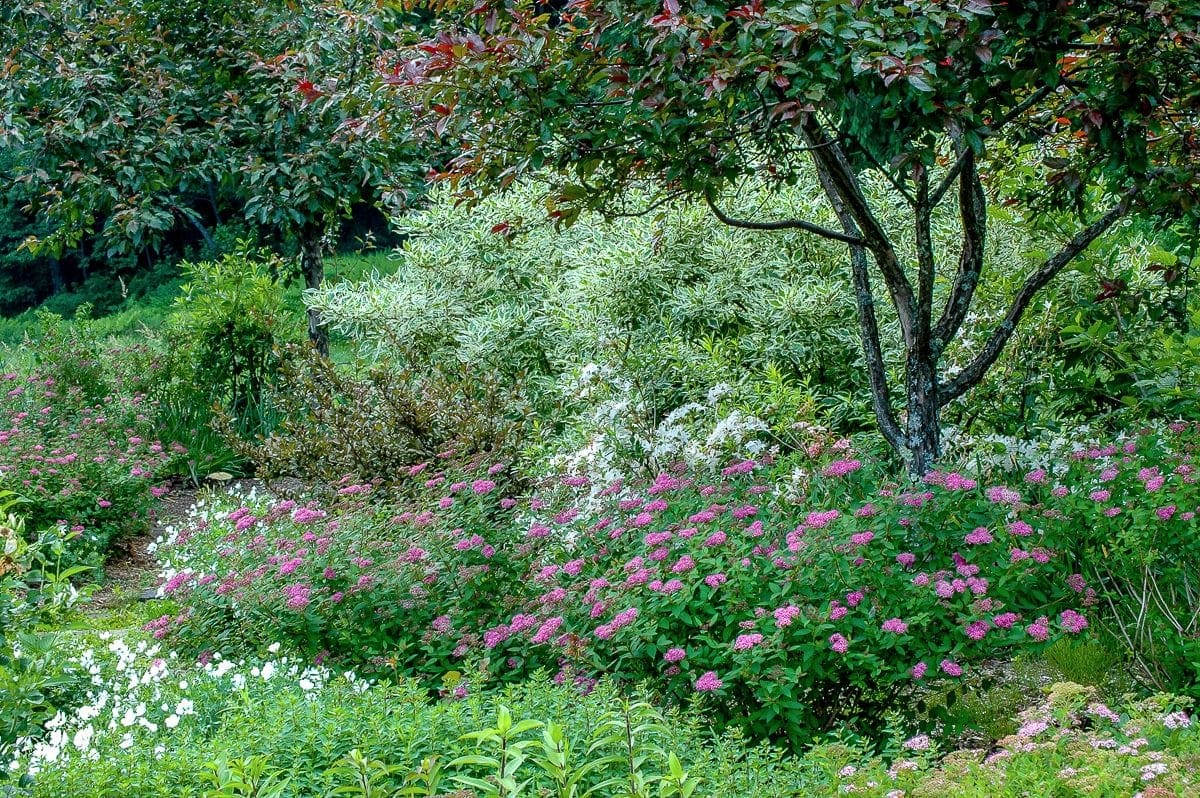
The young garden in summer, with the pink Norman spireas and towards the back, the white Weston’s Innocence azalea and the variegated Cornus ‘Ivory Halo’.
Surrounding the crab apples I planted a number of shrubs, including:
Five varieties of summer flowering azaleas, chosen for their succession of bloom time, as well as their wonderful fragrance: the first to flower is Weston’s Innocence in early June, followed by Jane Abbott and Parade, and finally, towards the end of July, Lemon Drop and Golden Showers.
Summersweet, Clethra alnifolia with its mesmerizing August fragrance.
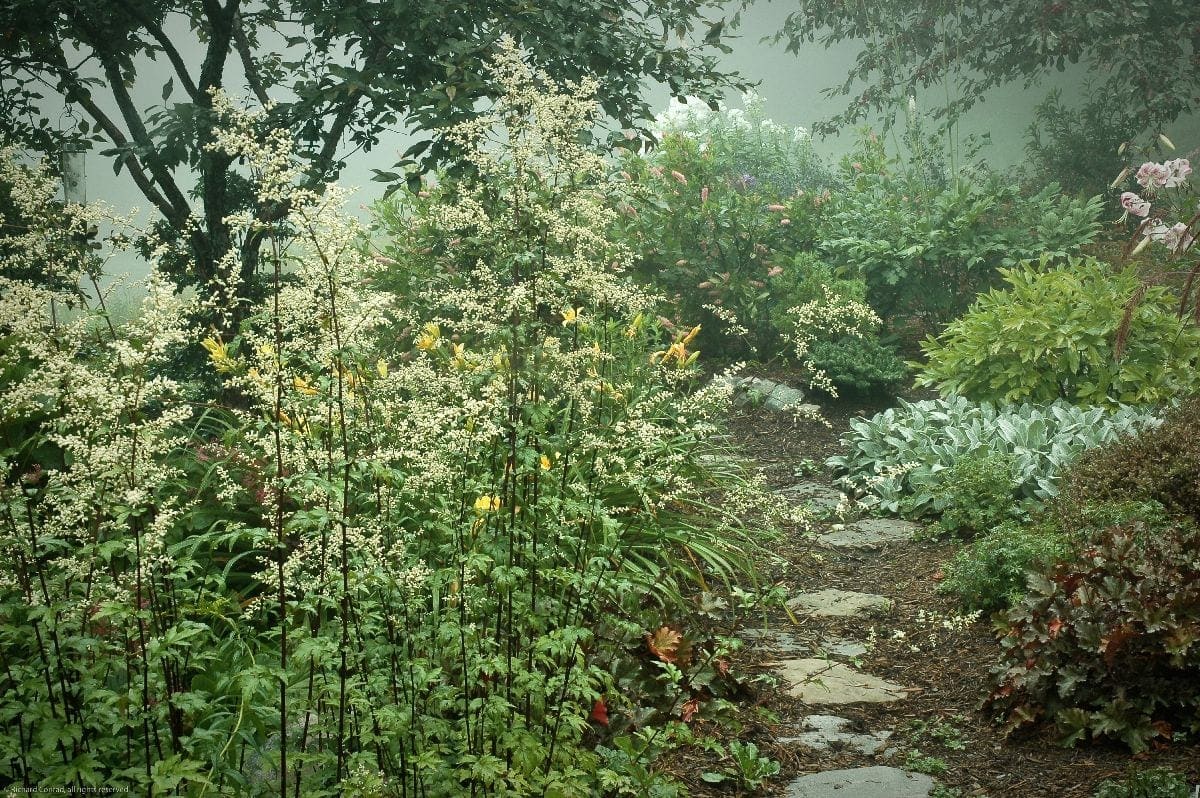
A stepping stone path circles through the entire bed
Three red-twigged dogwoods, Cornus ‘Ivory Halo’ have delicate cream-and-white variegated leaves, and a Weigelia ‘Wine and Roses’ a dark burgundy foliage for contrast.
A Fothergilla major and the native witchhazel, Hamamelis virginiana, both chosen specifically for their beautiful fall colors.
Two varieties of low growing spireas act as a ‘filler’ in the sunny spaces: Spirea ‘Norman’ in front of the crab apples, and Spirea ‘Little Princess along the south edge of the bed.
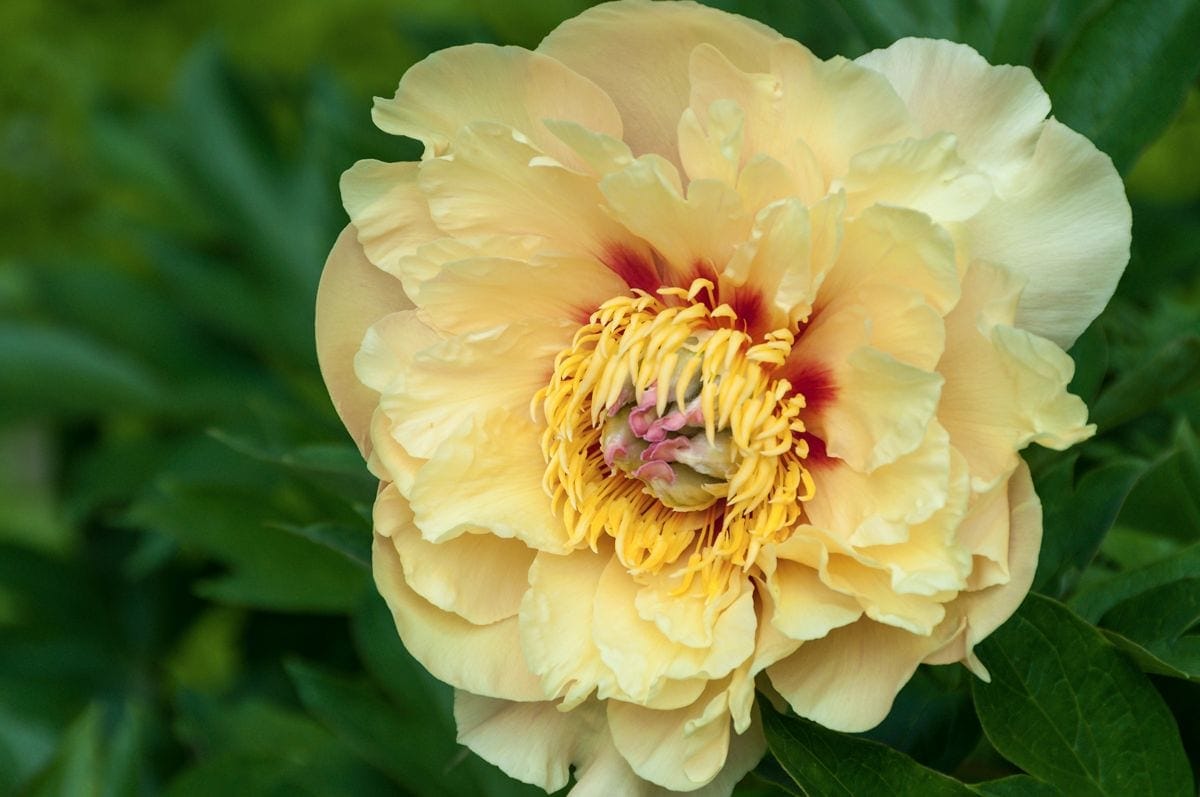
The hybrid peony ‘Garden Treasure’ is a special favorite.
I also found room for various ‘special plants’: a beloved tree peony; the beautiful hybrid yellow peony ‘Garden Treasure’; a dwarf white pine, Pinus strobus ‘Kurley’; and a low growing white rose, Rosa blanca.
Filling the spaces

The variegated foliage of Cornus ‘Ivory Halo’ create an attractive summer backdrop for the changing cast of perennials
In the spaces between the shrubs I used perennials that take partial shade, including a group fragrant yellow daylilies, tall pink oriental lilies among the big Japanese catmint (Nepeta subsessilis), some ornamental oregano that attracts late season butterflies, the low-growing lacy Filipendula ‘Kakome’, some delicate black-stemmed mugwort (Artemisia lactiflora ‘Guizhou‘), and a group of aromatic asters alongside clumps of fuzzy blue fescue.
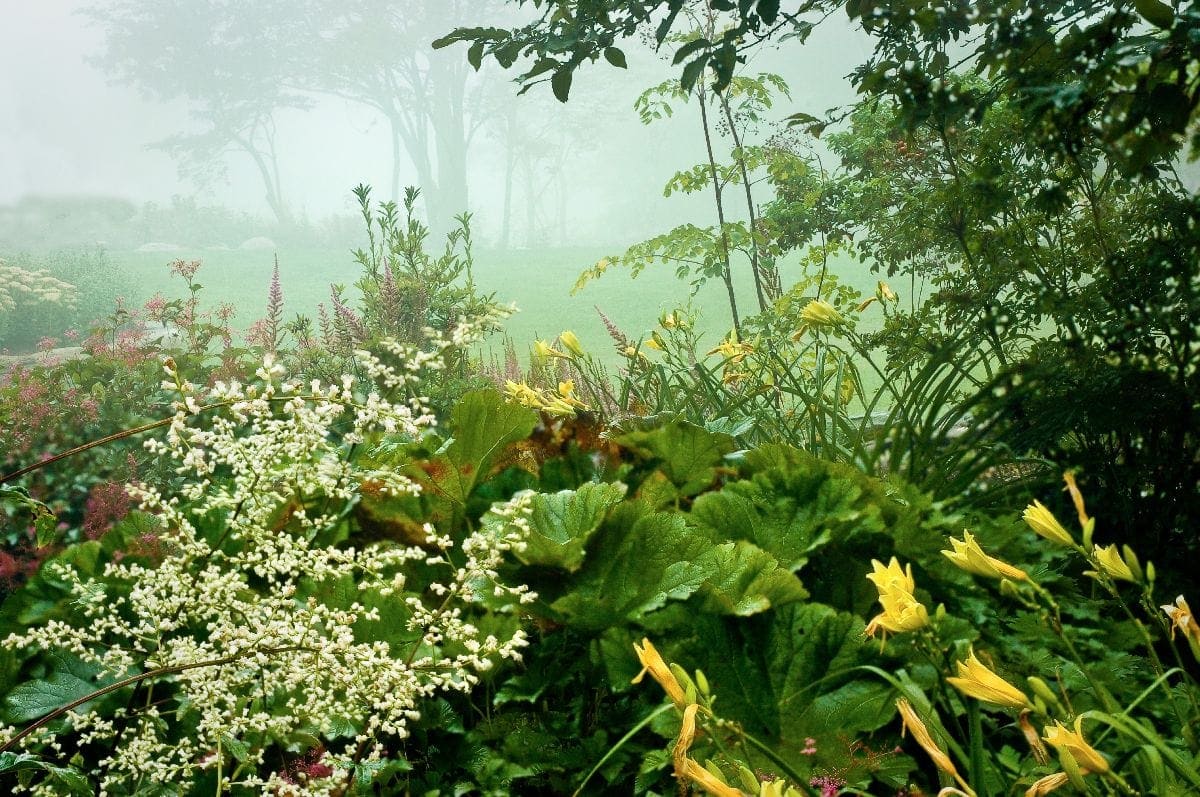
The lacy Artemesia ‘ Guizhou’ is the perfect foil for the drama of the Darmera
In the moist shade on the northeast side of the gazebo a grand patch of the umbrella plant, Darmera peltata, flourishes without encroaching. And, around the corner on the northwest side, a mass of pink and white Astilbe, ‘Peach Blossom’ and ‘Deutschland’ are especially pretty in July. Under the shrubs large patches of the groundcover Geranium machrorrhizum ‘Bevan’s Variety’ effectively suppress the weeds.
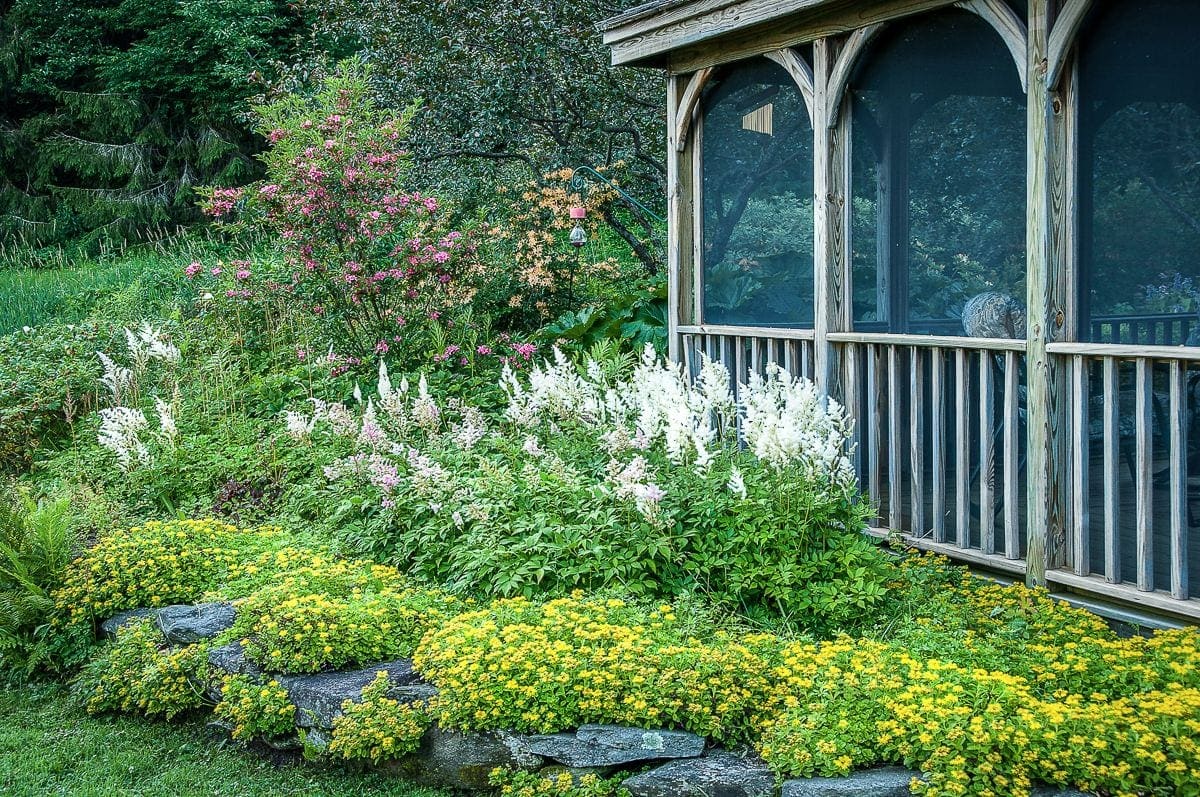
In the moist shade on the northwest wall of the gazebo pink and white Astilbe flourish. They are flanked the yellow Russian sedum.
On the sunny southeast and southwest sides of the gazebo the groundcover Russian Stonecrop, Sedum katschaticum, has multiplied profusely.
And finally, a small stone pedestal holds a large hand-thrown pot and a stepping stone path loops through the entire bed, inviting you to explore the garden and smell the flowers up close.
The gardener’s work continues
Over the years I have made a number of adjustments, both to respond to the increase in shade cast by the crab apples in the center part of the bed, and also to keep everything looking full but not overcrowded.

Everything has filled in to create a partially shady bed that is an avian magnet
Most obviously, as the Norman spireas in the center of the bed gradually became more shaded by the crab apples, they reacted by becoming thin and straggly. (By contrast, the Little Princess spireas on the sunny south side are doing just fine). Since spireas have very shallow roots, a couple of years ago in the fall it was a very easy job to lift them and replant them in an entirely different part of the garden. Back in the sun they have filled in again where they should be good for many more years.

A stepping stone path winds past an iconic blue pot
I then replaced the spireas with a couple of the recently-introduced dwarf Ninebark, Physocarpus ‘Little Devil’ which should be able to handle the shade, pairing them up with several plants of the aptly-named Hosta ‘Guacamole’, which will make a wonderful contrast in the shade.
The summer-flowering azaleas are doing beautifully in the filtered light. They are extremely floriferous and have the bonus of nice shiny leaves. However each year after they have flowered, I need to prune them down slightly to maintain them at the desired height—under 6 feet tall– to maintain a visual separation from the crab apples.
The delicate Artemisia ‘Guizhou’ has become swamped with weedy grass. So this year I will dig it up, soak the roots to disentangle the grass, then thoroughly weed the soil before replanting the roots.
And finally, the Geranium macrorrhizum has spread out further than I want. But it should be a relatively easy job to pull out the thick surface roots to get it back into proportion with everything else.
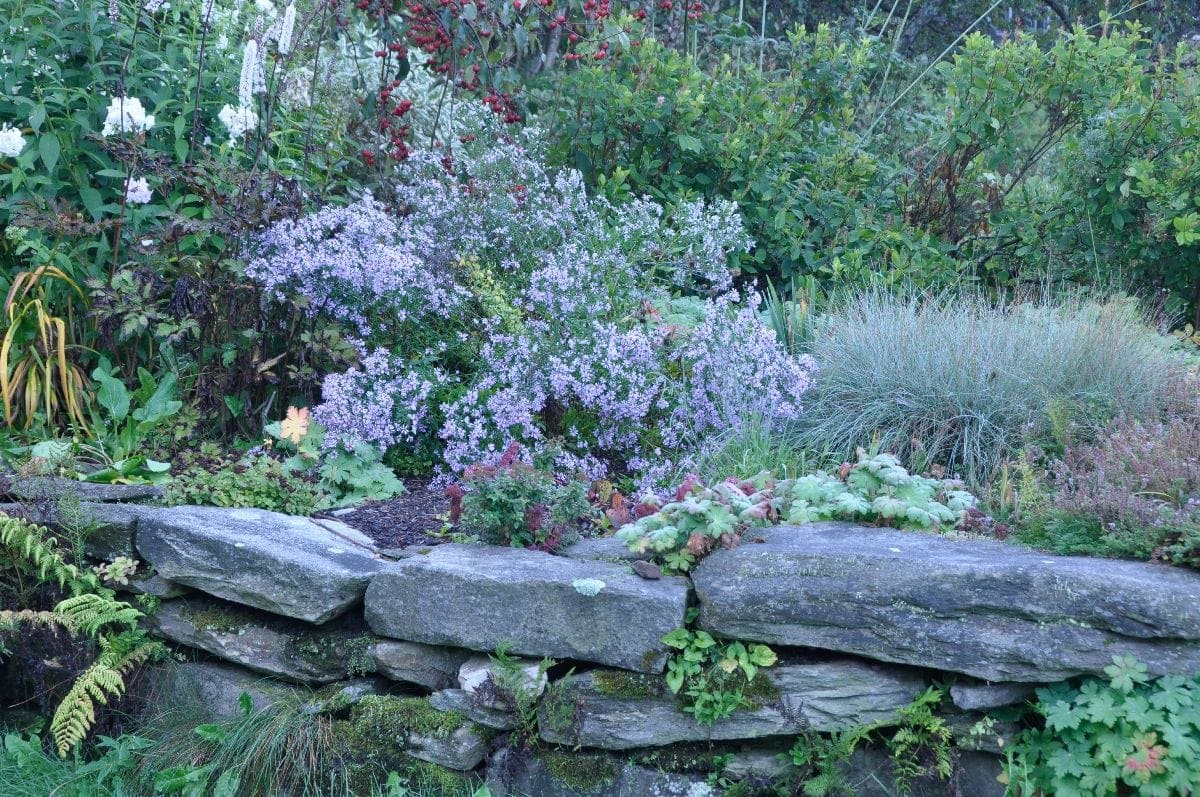
Aromatic asters and the fuzzy blue fescue in late fall
Thus the evolution of the garden continues and the work of the gardener goes on. But that is the way it should be. Again, to quote H.E. Bates,
‘The garden that is finished is dead’

Yellow daylilies set off by the blue sea holly Eryngium planum