Not-so-wild wildflowers
Shafts of sun streamed through the leafy canopy, highlighting an amazing array of wildflowers on the forest floor below.
.
Last Friday, when I visited Garden in the Woods in Framingham, Massachusetts, it was a quintessential spring day.
I chuckled as I remembered it was Friday May 13th, an unlucky date for the superstitious.
But not for me…. I had a splendid time.
.
Garden in the Woods
Back in 1933 Will Curtis, a landscape architect, and Howard Stiles together founded this 45-acre sanctuary to be a laboratory and a living museum.
One year later they wrote:
Garden in the Woods is a dream in the realization, a year’s long dream about a big wild garden in which plants will be grown, their likes and dislikes discovered, and the knowledge so gained passed on in an effort to curb the wholesale destruction of our most beautiful natives.
Their dream has been kept alive for more than three-quarters of a century. Now under the auspices of the New England Wildflower Association, Garden in the Woods offers a unique showcase of North American native shrubs and perennials growing in a beautiful naturalistic setting.
May is for wildflowers
Typically our woodland wildflowers blossom in the spring, before the tree canopy has completely filled in, so that they can make the most of the available light on the forest floor.
- Some, like Trillium and Spring Beauty, are ephemeral. Once their flowering cycle is complete they vanish below ground without trace, to return again next spring.
- Others, such as Bloodroot and Creeping Phlox, flower in the spring but the plants remain green all summer.
- And still others, like the Pinkshell Azaleas, Rhododendron vaseyi, and the Hobble-bush, Viburnum alnifolium, are shrubs that are around all year long.
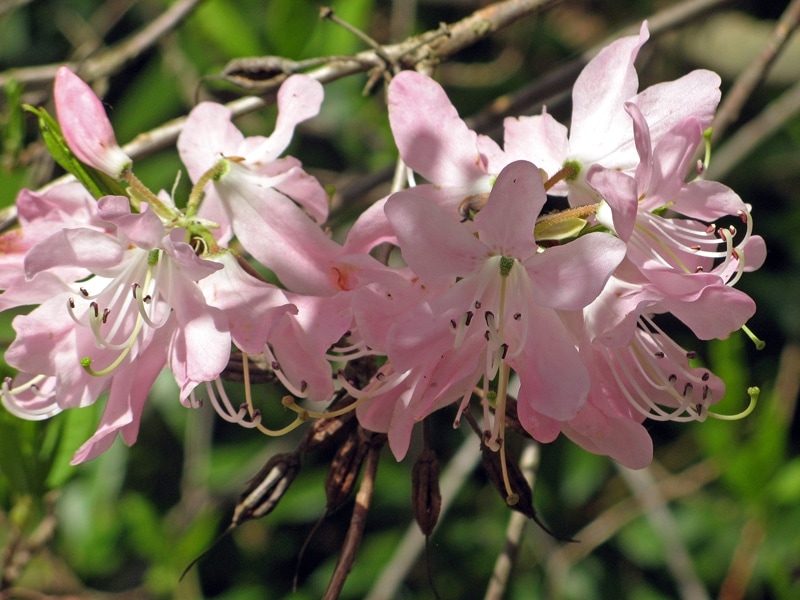
Pinkshell azaleas have soft pink flowers in May
Pinkshell azaleas are nothing short of spectacular in bloom, and there are specimens throughout Garden in the Woods. I love the form of this delicate open shrub and its soft pink flowers…so completely different from the heavy texture and strident purple of the ubiquitous PJM azaleas that I encountered in the nearby gardens of Framingham.

Creeping phlox
And equally lovely last Friday, was a mix of the soft lavender-colored creeping woodland phlox…Phlox stolonifera ‘Blue Ridge’, which was growing near some delicate yellow Celandine Poppies, Stylophorum diphyllum.
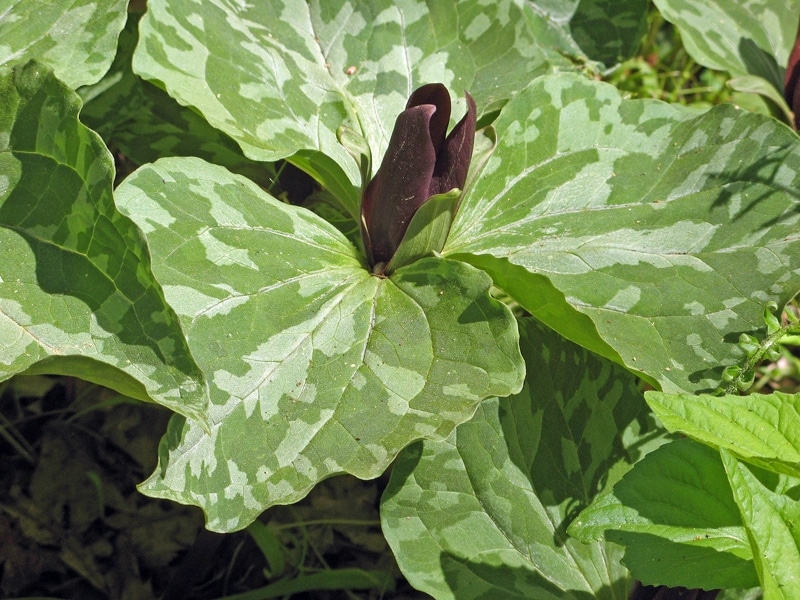
Whip-poor-will trillium
.
.
Garden visitors were also mesmerized by two different trillium. The whip-poor-will flower, Trillium cuneatum, is native in southeastern states and all the way up into Massachusetts, but apparently it does not extend to Vermont. However I am tempted to look for some from a mail-order catalog and try them in a sheltered corner of my garden.
.
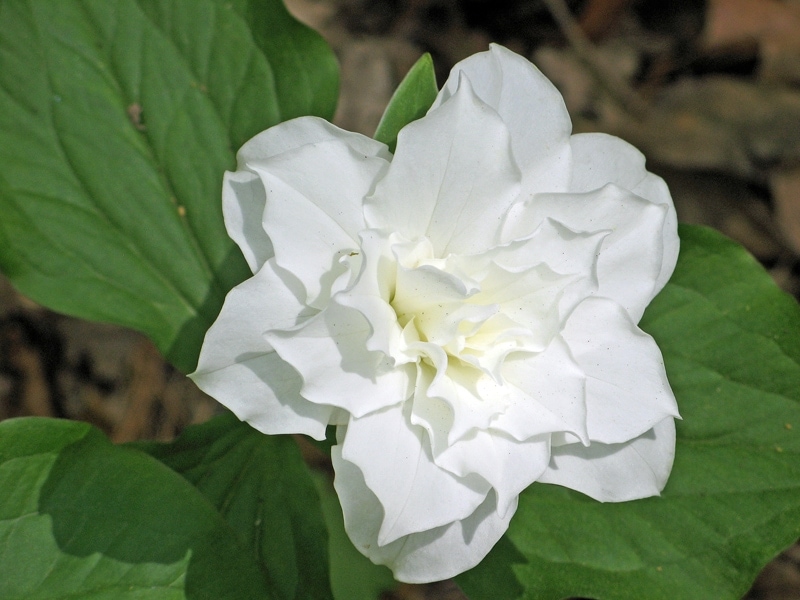
Double white wakerobin
And while we have white trillium in selected parts of Vermont I have never seen this beautiful double-flowered variety.
Following the Curtis Trail
The Curtis Trail is the main loop trail, around the property, about a mile in all.
The trail starts with the lovely woodland garden, and its lavish display of spring wildflowers nestled among last year’s brown leaves. From here one descends a rocky staircase to the Idea garden and the lower pond.

A group of turtles on the small island in the Lily Pond at Garden in the Woods
Last Friday some resident turtles were poking around on the small island in the middle of the pond…they seemed to be enjoying the sunny day as much as the visitors! And as I walked past its chosen spot at the edge of the pond the biggest bullfrog I have ever seen carefully eyed me.
The Curtis trail also goes past a number of discrete habitats, including several boggy areas with skunk cabbage and pitcher plants, as well as an open meadow that is home to many summer-blooming prairie flowers. Each habitat fosters its own unique plant population.
Tidy woods versus messy woods
Garden in the Woods, as its name implies, is indeed a garden..howbeit a very big one. And here, as in all gardens, humans strive to control nature, although in a very gentle manner.
Early in its existence, its creators removed spindly trees, leaving more robust specimens to grow and expand in girth. They also removed low growing understory shrubs and limbed up the remaining trees to make a high-arching overhead canopy. This all made for space and light on the forest floor to support the wildflowers.
An ongoing maintenance regime continues: the paths are kept smooth and fallen trees get tidied up (although some are left on the ground to rot and contribute humus to the forest).
This is all in marked contrast to the ‘real woods’ which I see in the National Forest around here. I real woods one often looks through a tangled mess of fallen trees and other evidences of nature’s more casual pruning style.
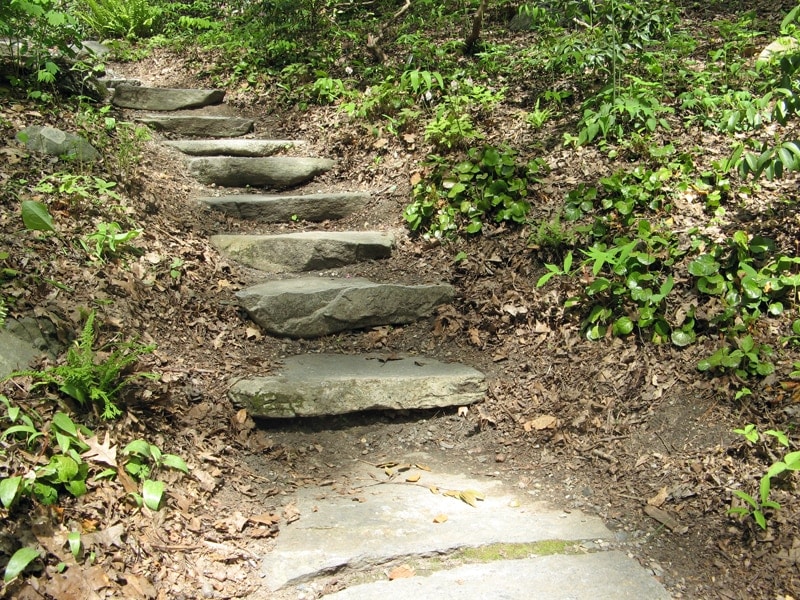
Along the Curtis Trail: A rock staircase
Making your own woodland garden
The lessons for those of us who have ‘woods’ on our properties where we would like to grow special plants are clear. To create your own garden spaces under a canopy of trees, follow this tried and true strategy:
- Prune out any dead branches at bottom of large trees.
- Remove skinny saplings and scrubby underbrush.
- Take out some additional trees, which will allow the ones you leave to grow larger.
- Remove the lower branches of these remaining trees to a height of 20 or more feet.
- Create paths and steps using rocks, chopped leaves or a layer of woodchips.
- On either side of the paths introduce selected understory shrubs as well as ferns and wildflowers.