Serendipity in the garden
When it comes to gardens I am big on planning. It comes, I suppose, with being a landscape designer
Moreover, I frequent the world of the Master Gardeners where our oft-repeated maxim is:
Right Plant– Right Place
This is all about knowing your plants and how they are expected to behave in different settings, so that you plant them with an eye to the future and don’t have any nasty surprises down the line.
Serendipity— those happy accidents
But I also love serendipity– little surprises that pop up unexpectedly in the garden. They serve remind me that, though I might like to think I am in control of my outdoor world, this is not always the case.
Certainly not every garden surprise will be for the good—I think about the legions of dandelions that emerged among the blueberries last spring.
But it is those unexpected and beautiful ‘little somethings’ that allow me to enjoy the garden with fresh eyes.
Here are five ‘happy accidents’ from this year’s garden:
Among the stones
We have always had a small bench on the little patio outside our front door. 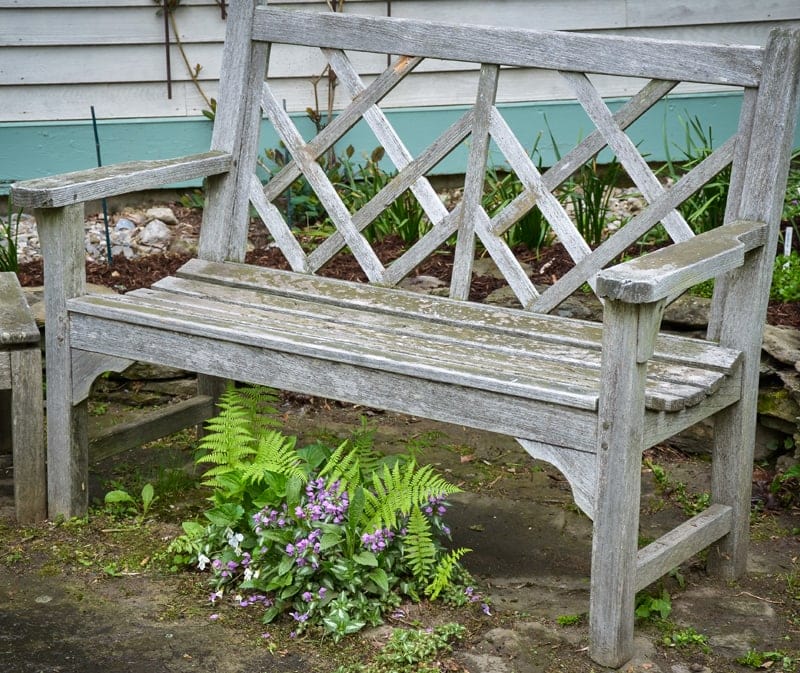 Over the years Dick and I have enjoyed many cups of tea there together, especially in early spring and late summer where this sheltered spot catches the sun but is out of the wind.
Well, last spring this delightful arrangement of plants arrived —completely unannounced—eking out a living between the field-stones under the bench. It included Lamium, Violets and a small fern—I could not have put together anything more charming if I had tried!
.
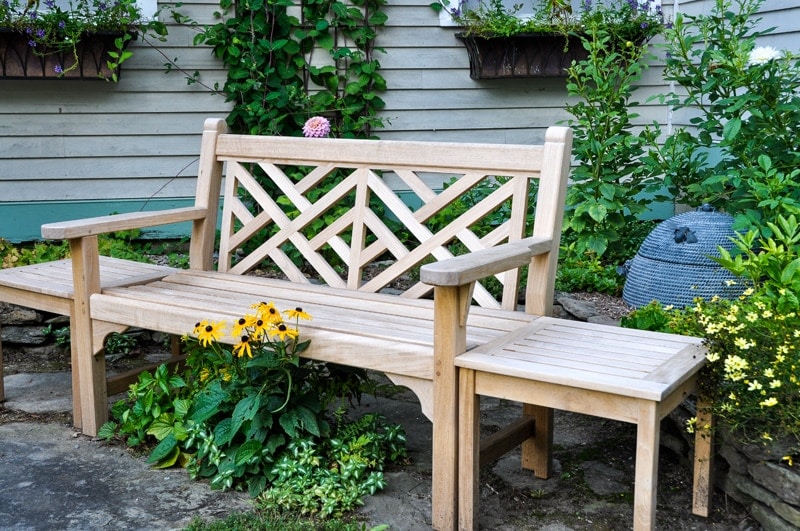
And as summer progressed the larger leaves hiding among the early mix turned out to be those of Black-eyed Susans. Here is the same scene (howbeit with a new bench) in August!
.
.
 Between the roots
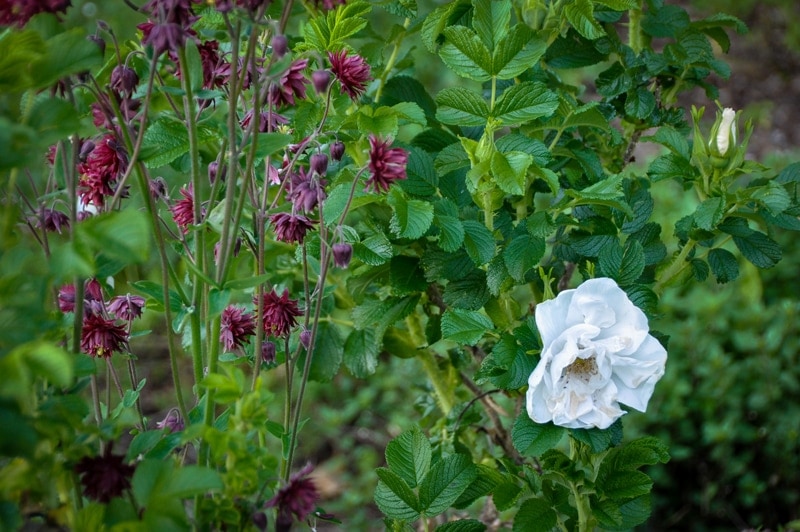
And as if my patio planting was not sufficient to make me a fan of serendipity, last June I discovered this delectable duo in the bed outside our gazebo: a beautiful double-flowered Aquilegia, the color of burgandy wine, growing straight up from the middle of this pure white Rosa alba.
The columbine, I presume, was self seeded, although I am not aware of any other Aquilegias that color elsewhere in the garden.
And since its roots are locked together in a firm embrace with the rose, that is how they will stay. And I am certainly looking forward to greeting them again next year.
A quirky bird-feeder
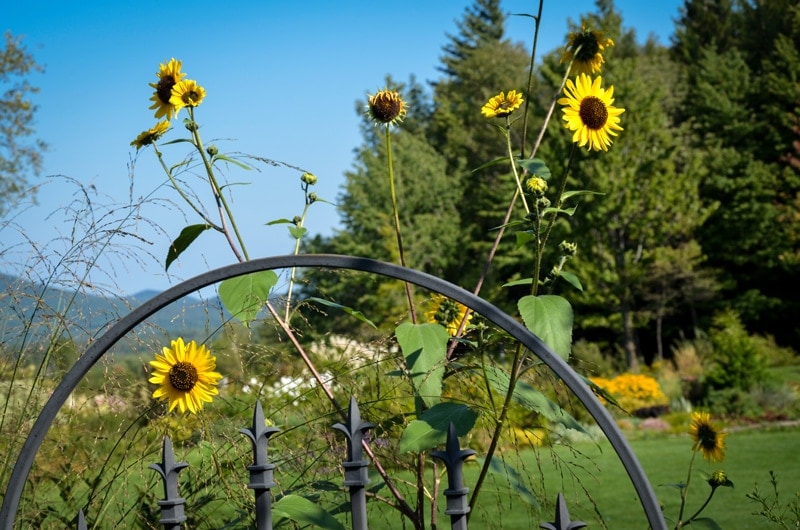 This spring we watched as a new plant emerged in the bed front of our kitchen window. I realized it was a sunflower, presumably growing from a seed dropped by a chickadee last winter. Out of curiosity I left it, although fully expecting it to amount to nothing, as from experience I know that birdseed sunflowers are usually puny.
However this one proved to be the exception. Maybe it is not a truly beautiful plant, but for a couple of months it has created an interesting silhouette against the backdrop of the larger garden beyond.
And as fall approaches, the returning chickadees, along with some song sparrows, are swarming over it to peck out the seed, and it is fulfilling its destiny as a bird-feeder too.
Timing is everything

Swallowtail butterflies swarm over the Littleleaf lilac, Syringa Myerii
It was a happy accident when I decided to plant a row of Littleaf Lilac bushes (Syringa myerii) outside our bedroom window. I chose that particular shrub because it would be a good height for the spot and we would enjoy the pretty lilac colored flowers from the window.
But nothing prepared me for the swarms of swallowtail butterflies that are drawn to these small flowers for two weeks each June.The butterflies can’t seem to get enough of them. According to Wikipedia, swallowtail butterflies are attracted to sturdy plants with pink and red flowers, and all kinds of lilacs seem to fit the bill.
However there are plenty of Common Lilacs (Syringa vulgaris) growing in the garden, but most years they boast only a paltry number of butterfly visitors. Since they bloom here about two weeks before S. myerii, I conclude this is usually slightly ahead of the emergence of the swallowtails.
Oh! the difference a couple of weeks makes!
A planting scheme gets modified
A few years ago my autumn garden project was to renovate the overgrown slope that leads to the old barn on the hill, and make it into a real garden.
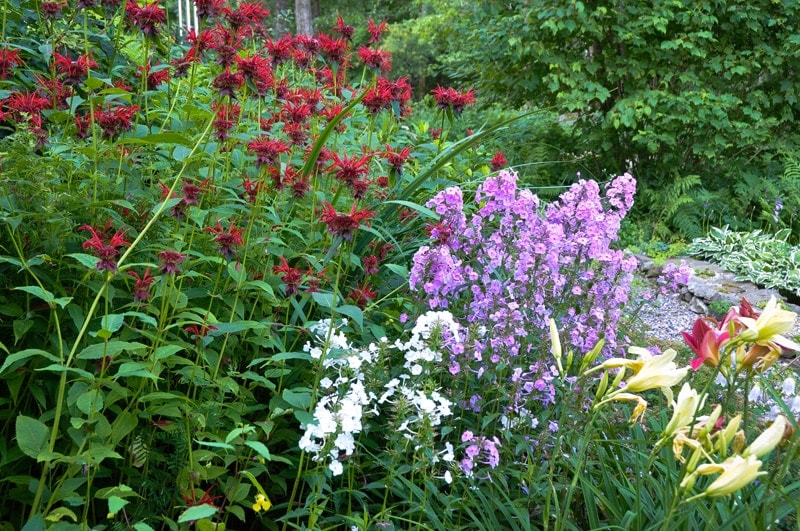
Monarda ‘Jacob Cline’ with Pholx maculata ‘Rosalinde’
I had a number of interesting perennials at my disposal, which I wanted to ‘mix and match’ to create a new planting scheme. These included various shades of daylilies, some of the tall scarlet bee balm, Monarda ‘Jacob Cline’, and a few clumps of the magenta colored early flowering phlox, Phlox maculata ‘Rosalinde.
However I vaguely recalled the conventional wisdom dictate whispering in my head that magenta and red do not ‘go together’. So I carefully positioned the scarlet Jacob Cline a fair distance from the magenta Rosalinde.
But we all know that Monardas are runners, and lo and behold, Jacob Cline has now showed up right behind Rosalinde, and for much of July they are in bloom together.
I could not be more pleased with the resulting color pairing, and especially the way it is set off with some of white Phlox maculata ‘Miss Lingard’ and some pale lemon daylilies. And all these the bright colors show off vividly when I look up at this slope from the house.
Another happy accident in the garden!
How much control does the gardener have?
We gardeners like to think we are in control as we choreograph pictures with our plants. Certainly the topic of designing borders with particular color schemes has been discussed for well over 100 years now (going back to Gertrude Jekyll and earlier). And today’s garden magazines certainly abound with articles relating to ‘planting companions’.
But so often we forget the ever-present fourth dimension of time. The passage of time gradually modifies even the most carefully planned planting schemes. Sometimes a few years is all that it takes for the integrity of our initial vision becomes diluted and muddled.
But it also behooves us to be open to serendipity in the garden. You never know when time will yield something that is both unplanned and beautiful.
And that is what I love about gardening.